

This morning I found myself watching a freight train passing through the cane country between Mackay and Airlie Beach in Queensland, Australia.
Container after container rolled north along the rail line beside the Bruce Highway.
Where most people would see a freight train.
I saw a question…
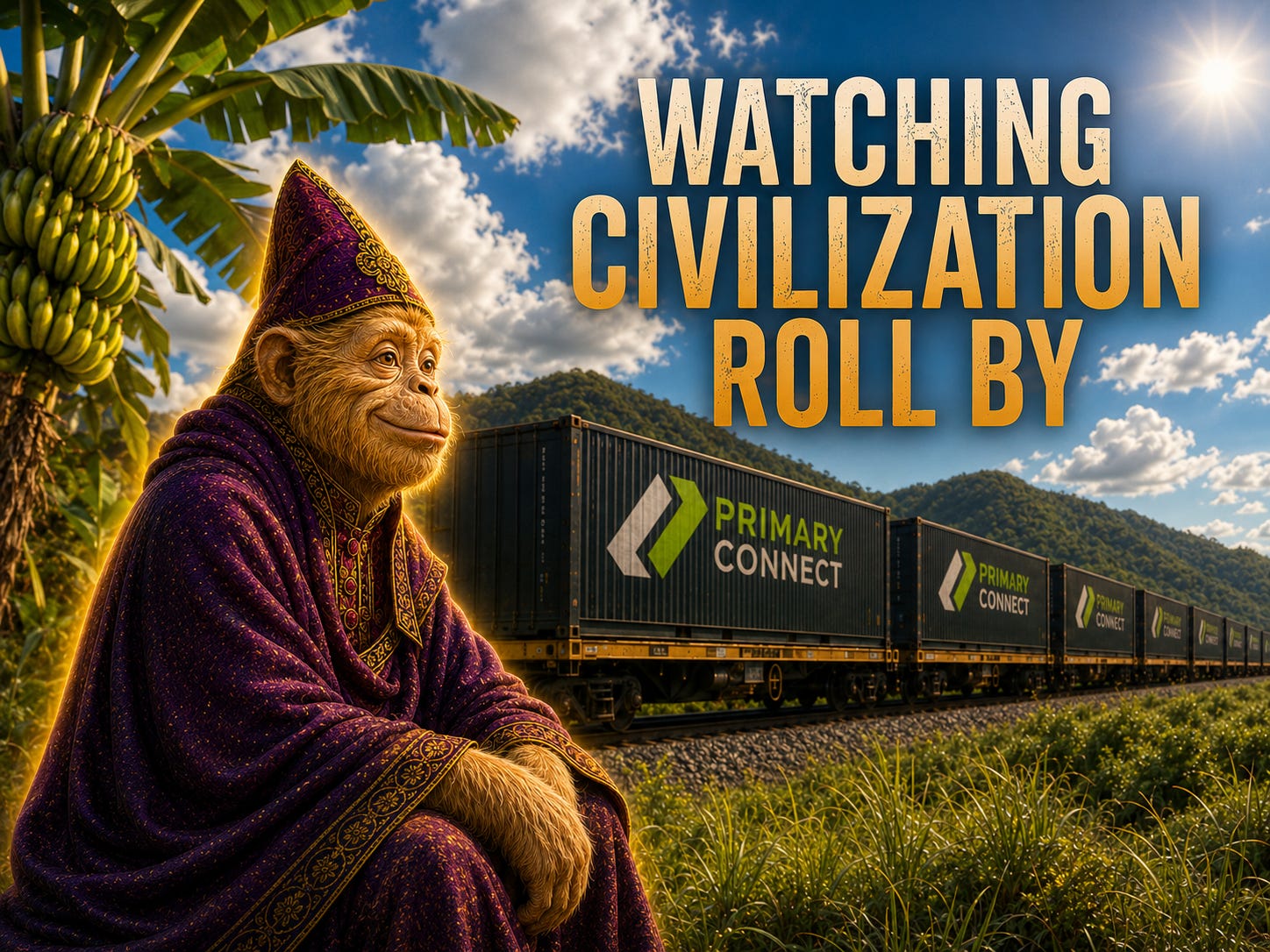
Many of the containers belonged to Primary Connect — which, after a little research, I found out is the logistics arm of Woolworths. Inside those steel boxes sat groceries, fresh produce, frozen foods, household goods, beverages, packaging, machinery, spare parts, and countless other products destined for supermarket shelves across Australia.
And suddenly it struck me:
I wasn’t just watching a train.
I was watching the bloodstream of modern civilisation.
Every container represented calories, resources, labour, energy, information, and coordination moving through a vast continental organism. A packet of seeds produced in one region. Machinery manufactured in another. Food grown hundreds or thousands of kilometres away. Packaging produced elsewhere again. All converging through an intricate web of roads, ports, warehouses, railways, software systems, distribution centres, procurement teams, fuel networks, maintenance crews, and invisible agreements.
It is an extraordinary achievement.
For all the criticism industrial civilisation receives, there is something genuinely remarkable here.
Fresh food appears on supermarket shelves every day across a continent-sized nation.
Millions of people eat because an almost unimaginable level of coordination quietly unfolds behind the scenes.
The train deserves respect.
Yet the train reveals something else.
Dependence.
Many communities now hold only a few weeks of food locally. The abundance surrounding us exists because trains keep moving, trucks keep driving, ports keep unloading, warehouses keep operating, fuel keeps flowing, software keeps coordinating, and thousands of people continue performing their specialised roles in logistics.
The abundance is real.
The resilience is a separate question.
The Great Inversion
For most of human history, food moved relatively short distances.
Communities were fed by surrounding landscapes.
Knowledge travelled.
Stories travelled.
People travelled.
Trade travelled.
Yet the foundations of survival were usually local.
Food, fertility, seed, labour, water, shelter, and community emerged from relationships with place.
Industrial civilisation inverted the pattern.
Food travelled further.
Production concentrated into fewer locations.
Scale increased.
Efficiency increased.
Output increased.
The network expanded.
A person could eat bananas grown in another state, machinery built overseas, and ingredients sourced from multiple continents without giving any thought to the immense choreography required to make it happen.
And the system worked.
Remarkably well.
Now another inversion appears to be emerging.
Not a rejection of global civilisation.
An integration.
For the first time in history, knowledge can move globally while production can move locally.
A gardener in North Queensland can learn from a farmer in Colombia.
A market gardener can access information that previously lived only inside universities.
Open-source communities can share designs, systems, research, seeds, software, and solutions across continents in real time.
Artificial intelligence accelerates this even further.
The internet allows information to become increasingly global while production has the opportunity to become increasingly local.
This changes everything.
Community-supported agriculture.
Market gardens.
Food forests.
Seed saving.
Tool libraries.
Shared kitchens.
Regenerative enterprises.
Distributed manufacturing.
Local energy systems.
None of these require isolation from the global system.
They require participation within it from a different orientation.
Global knowledge.
Local resilience.
Global connection.
Local production.
Global communication.
Local nourishment.
Nature’s Logistics Network
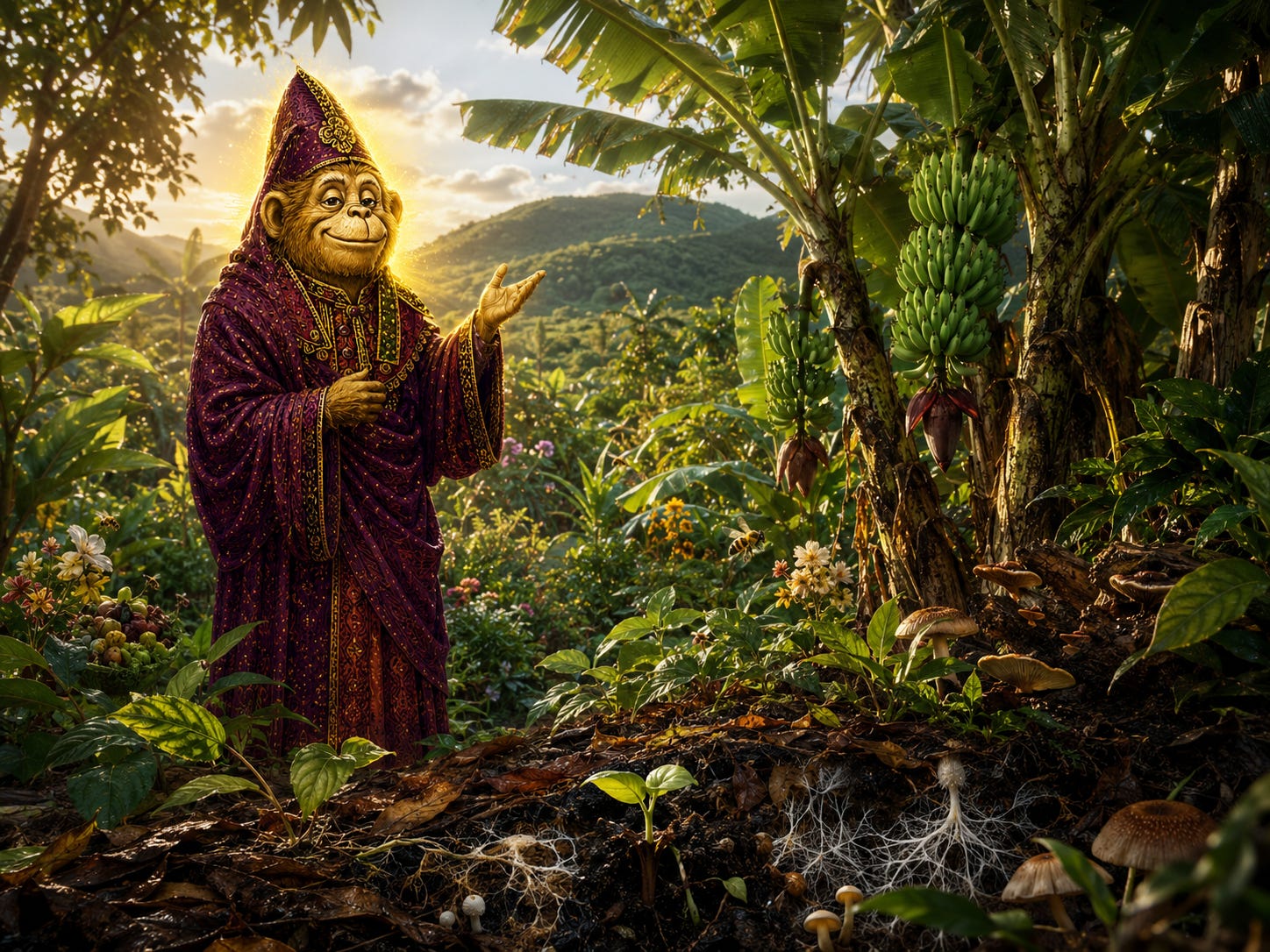
The more I sit with this possibility, the more I notice that nature solved the logistics problem long ago.
A food forest is a logistics network.
Sunlight enters the system.
Rain enters the system.
Minerals rise through roots.
Fungi transport nutrients.
Bees move pollen.
Microbes exchange chemistry.
Leaves become compost.
Compost becomes fertility.
Fertility becomes fruit.
Fruit becomes seeds.
Seeds become future forests.
Nothing is wasted.
Everything circulates.
The forest distributes abundance without warehouses, shipping manifests, procurement teams, inventory software, freight schedules, or quarterly reports.
It coordinates through relationship.
A banana itself is simply a biological shipping container.
Inside its yellow packaging sits stored sunlight, minerals, water, sugars, microbial relationships, genetic information, and future possibility.
Nature invented logistics before humans invented railways.
The Wealth Hidden in Plain Sight
Which raises an even deeper question.
What is wealth?
Modern civilisation became extraordinarily skilled at measuring financial and material capital.
Money.
Infrastructure.
Machinery.
Products.
Assets.
And these forms of wealth matter.
The train proves that.
Yet a food forest reveals other forms of wealth that rarely appear on balance sheets.
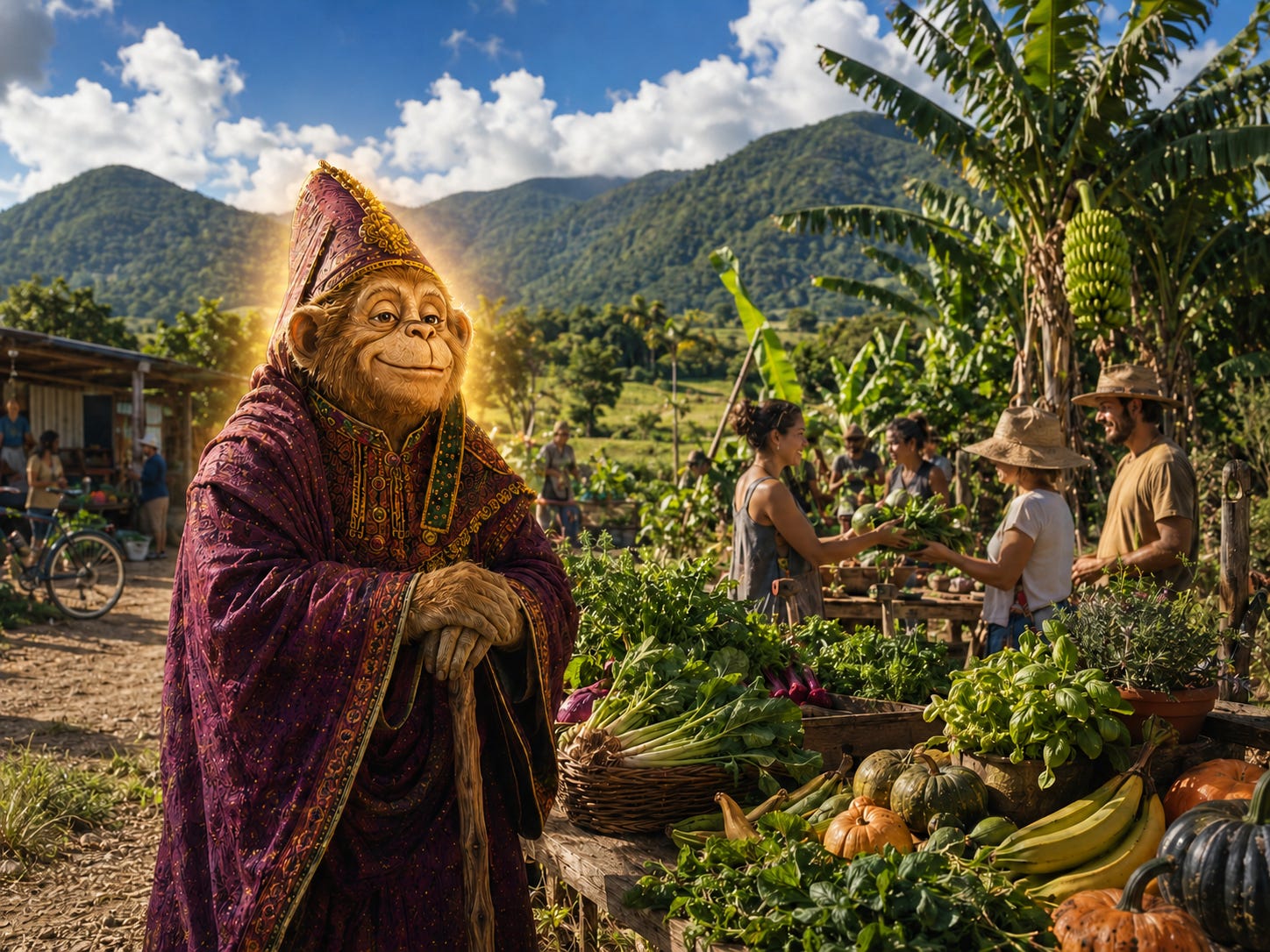
Healthy soil.
Local knowledge.
Seeds adapted to place.
Trust between neighbours.
Shared skills.
Community memory.
Cultural stories.
Healthy bodies.
Strong relationships.
Meaningful work.
A living ecosystem capable of feeding future generations.
This is where a framework like Holistic Capital becomes useful.
Holistic Capital is a movement and philosophy that reframes wealth as something far larger than money alone. It speaks of multiple forms of capital — financial, material, living, social, cultural, intellectual, experiential, and spiritual — all woven together as one ecology of value.
That lens gives language to something the land already knows.
A community with money and empty soil is wealthy in one sense and poor in another.
A community with fertile land, trusted relationships, shared tools, practical knowledge, local food, cultural memory, and spiritual coherence carries forms of wealth that industrial accounting struggles to see.
The train moves products.
The forest creates wealth.
Those are related ideas.
They are not identical ideas.
Between the Container and the Banana
One can imagine a future civilisation that combines both.
A civilisation capable of maintaining global communication networks, scientific collaboration, open-source knowledge systems, advanced medicine, and technological innovation while simultaneously rebuilding local food systems, local resilience, local culture, and local sovereignty.
Not global versus local.
Global and local.
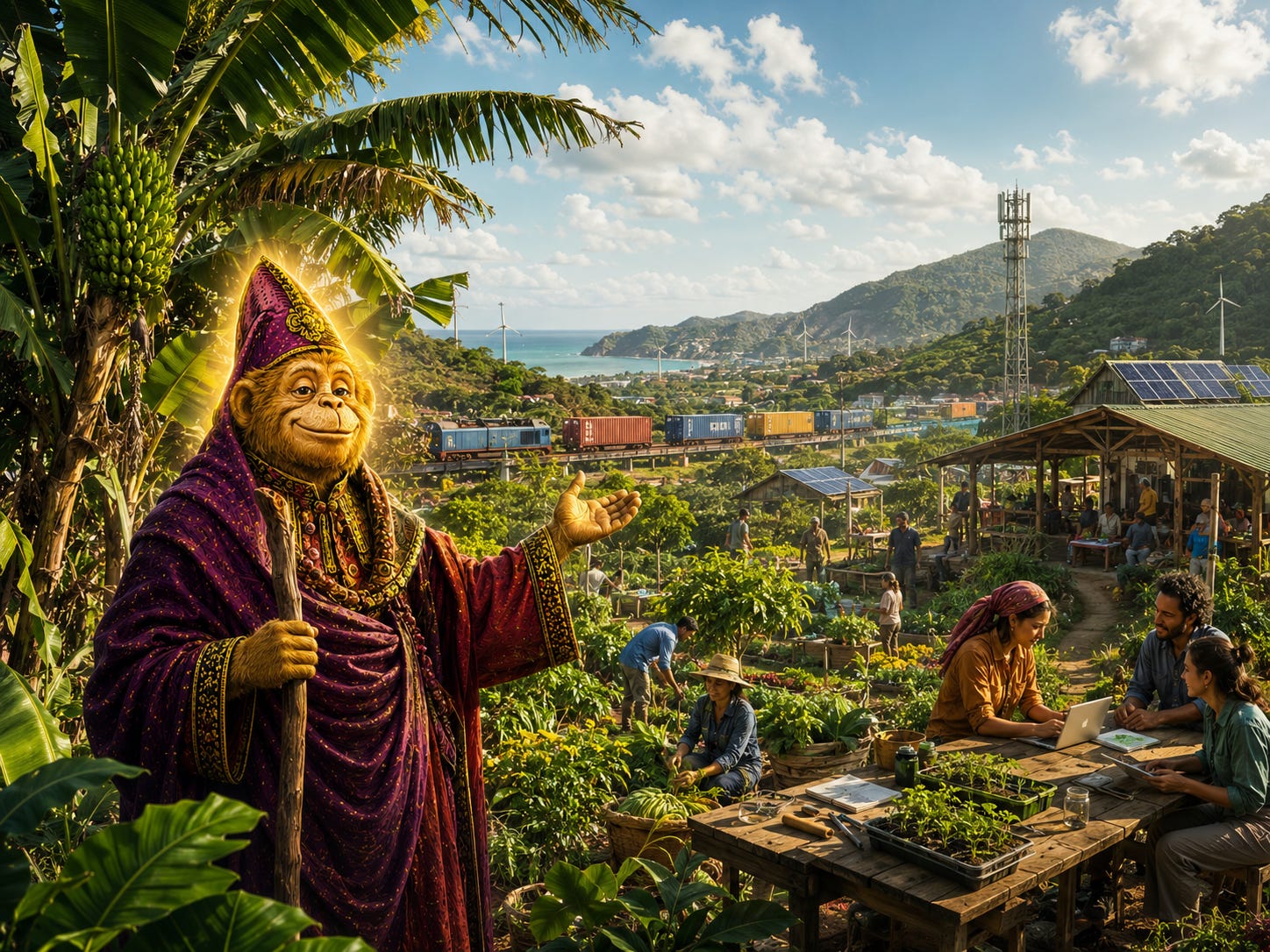
Not centralisation versus decentralisation.
A healthy dance between the two.
The train keeps moving.
The food forest keeps growing.
One carries abundance across a continent.
The other teaches abundance how to emerge from a place.
Civilisation may need both.
And somewhere between the steel container and the banana, a new story is already being written.
A story where information travels globally.
Food grows locally.
Communities become resilient again.
And wealth becomes something larger than money alone.
The train rolled north.
The monkey stood beside the tracks.
And for a moment, civilization revealed itself.