
Tinctures, Titian & the Magnum Opus
A botanical alchemist, an inherited Renaissance mystery, and a lifetime of inquiry

Some of the most significant encounters on a journey are not the ones marked on the map. They arrive sideways…
A conversation becomes an invitation. An invitation opens a door. Before long, you find yourself standing inside another person’s universe.
While traveling through the Sunshine Coast, I met a botanical alchemist.
His eccentric, excitable nature announced itself almost immediately. There was no long period of polite orientation. Within moments, we were being ushered toward his laboratory, where bottles, herbs, extracts and preparations revealed the practical side of a mind that had spent years investigating the healing qualities of plants.
He began offering me tastes of his tinctures, by the time we were through I must have already been half tipsy!
It quickly became clear that this was not simply a man making herbal extracts.
I had just entered the world of a real botanical alchemist.
Yet the laboratory was only the first chamber.
As the evening unfolded, another aspect of his character took centre stage. The botanical alchemist gave way to the polymath. His attention moved freely between chemistry, mythology, theology, Renaissance history, symbolism, philosophy, ancient mystery traditions and the work of Titian.
For a neurotypical mind the conversation might have felt as though it were jumping randomly from subject to subject. Although in an alchemists mind, these things all belong together in correspondence.
The plant, the pigment, the myth, the painting and the human being were not isolated objects of study.
They were parts of one investigation.
Then the evening opened into the work that has occupied a major part of his life.
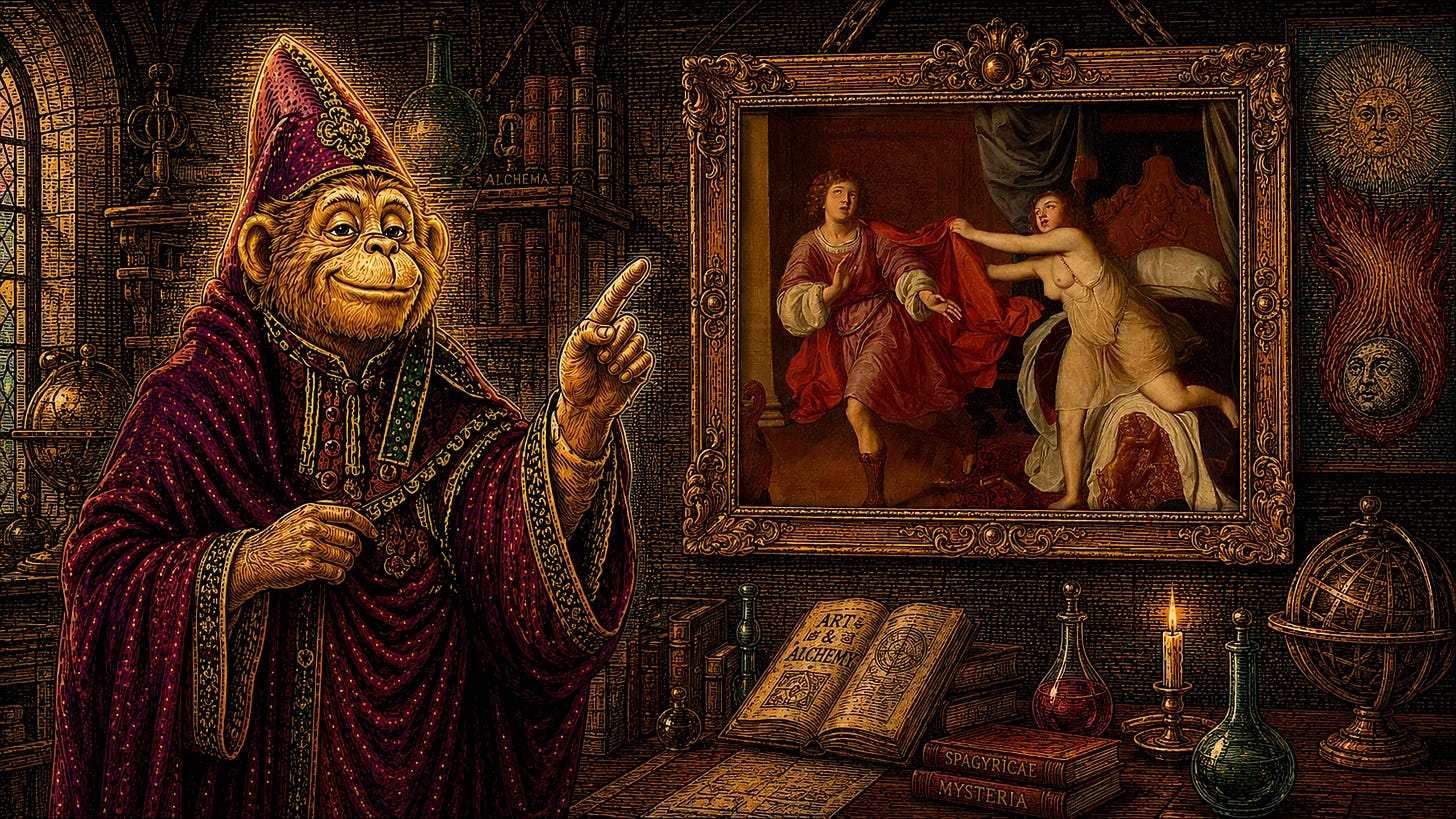
He began showing us the extraordinary body of research he had assembled around this painting he had inherited: reproductions, reports, historical investigations, technical analyses, symbolic correspondences and the accumulating architecture of an argument he has been developing for decades.
The current accepted interpretation of the work identifies the scene as the biblical story of Joseph and Potiphar’s wife.
In the Book of Genesis, Joseph serves in the household of Potiphar, an Egyptian official. Potiphar’s wife repeatedly attempts to seduce him. Joseph refuses. When she seizes his garment, he flees, leaving it behind in her hands. She then uses the garment as evidence in a false accusation against him, and Joseph is imprisoned.
The visual elements associated with that story are clear enough: a young man withdrawing, a woman grasping at him, a bedchamber and the captured garment that will become the instrument of accusation.
However Ian believes the work may be something much deeper.
He has spent years attempting to demonstrate that the accepted biblical identification does not exhaust the painting’s meaning. His thesis moves through Renaissance art history, technical examination, classical mythology, symbolism and the intellectual world of the Renaissance humanists. He suspects that the work may carry an older initiatory or mythological dimension, possibly connected to the story of Cybele and Attis, and that it may belong within the orbit of Titian and the much broader alchemical, philosophical and theological currents of the Renaissance.
These are substantial claims.
However they are not yet officially accepted as established art history. Attribution, provenance and iconographic interpretation require evidence that can survive independent scholarly scrutiny.
Although as Ian spoke, I realized that the deeper story before me was not merely whether his conclusion would ultimately be accepted by the mainstream academia.
It was the life that had formed around the inquiry.
This painting has become his Magnum Opus.
Not simply an object he wished to authenticate, rather the crucible into which he had poured decades of attention, research, doubt, excitement, rejection, discovery and renewed effort.
He had inherited a painting.
Although the painting had also inherited him.
When the Work Begins Working on Us
The Latin expression Magnum Opus means the Great Work.
In alchemy, it refers to the long process through which the prima materia—the raw, chaotic unrefined substance—is subjected to dissolution, separation, purification, transformation and reunion.
The familiar image is the transformation of lead into gold.
Yet in the deeper alchemical tradition, the matter in the vessel and the consciousness of the alchemist were never entirely separate.
The alchemist worked upon the substance.
The substance worked upon the alchemist.
Every failed experiment refined the experimenter. Every apparent dead-end exposed an assumption. Every return to the furnace demanded greater patience, finer perception and a more disciplined relationship with reality.
That is what I began to see in Ian’s research.
The painting was the matter in the vessel, but the decades of study had also been transforming the man studying it.
What began as an inherited object had become an organizing principle for an entire life of inquiry. Botany, chemistry, history, symbolism, theology and art had gathered around it. One question had drawn many disciplines into relationship.
The work had become far larger than the object itself.
And this brought us to a word Ian kept using throughout the evening:
“Humanist.”
I had no idea what he was talking about until I later researched the meaning of the word.
What Is a Humanist?
The word humanist is difficult because its present-day meaning is not the same as its Renaissance meaning.
Today, humanism often refers to a secular ethical worldview centered on human welfare, reason and moral responsibility without dependence upon religious revelation. A modern humanist may or may not be religious, but the word is commonly associated with secular philosophy.
That is not primarily what Renaissance thinkers meant.
The historical thread leads us back through the Italian word “umanista” to the Latin “humanitas”.
Humanitas did not simply mean humanity as a collective population.
Nor did it merely mean kindness toward other people.
It referred to the cultivation of the human being.
To possess humanitas was to become educated, articulate, ethically formed, intellectually alive and capable of participating wisely in civic and cultural life.
It meant refinement—although not refinement as social polish alone.
It meant the flowering of human potential.
The Renaissance humanists turned toward language, rhetoric, poetry, history, philosophy and classical literature because they believed these disciplines shaped the person studying them. Education was not simply the transfer of information from a book into the mind.
Education was formation.
The question was not merely:
“What do you know?”
It was:
“What kind of human being is this knowledge making you?”
This is the essence of humanitas.
A humanist, in the Renaissance sense, was someone committed to cultivating the capacities that make a human being fully human: reason, imagination, eloquence, moral judgment, historical understanding, aesthetic sensitivity and the ability to discern truth.
This was not necessarily a rebellion against Christianity.
Many Renaissance humanists were committed Christians. They did not always see classical philosophy and Christian revelation as enemies. They believed the wisdom of Greece and Rome could deepen the understanding of scripture, ethics, beauty and the divine order.
The distinction was not simply Pagan versus Christian.
The humanist mind asked whether different traditions might illuminate one another.
The Return to the Sources
One of the central impulses of Renaissance humanism was expressed in the phrase:
Ad fontes.
To the sources.
The humanists wanted to return to original texts rather than depending entirely upon generations of inherited commentary.
They studied Greek so they could read Plato and the New Testament in their earlier forms.
They recovered Roman works that had been neglected or lost.
They examined language carefully, because they understood that meaning changes when words pass through centuries of translation and interpretation.
This movement helped reopen the intellectual world of antiquity.
Plato returned.
Cicero returned.
Homer returned.
Greek philosophy, Roman literature and early Christian texts were read with renewed intensity.
For some thinkers, this recovery generated an even more expansive possibility: perhaps humanity’s oldest traditions contained fragments of a primordial wisdom.
This idea is sometimes called the prisca theologia—the ancient theology.
According to this vision, traces of divine truth might be found not only in the Bible but also in Plato, Pythagoras, Orpheus, Hermes Trismegistus, the Chaldean traditions and other ancient streams of thought.
The claim was not always that every tradition taught exactly the same thing.
It was that truth might cast more than one shadow.
A myth could contain philosophy.
A planetary image could contain theology.
A biblical story could echo an older archetypal structure.
A painting could communicate simultaneously through colour, gesture, scripture, classical mythology and sacred geometry.
This is the intellectual atmosphere Ian continually returned to when discussing his research.
He was not asking us to imagine Renaissance art as merely decorative or literal.
He was describing a world in which art could operate as a vessel of layered knowledge.
Humanist or Polymath?
At one point I wondered whether humanist was simply another word for polymath.
The two ideas certainly overlap, however they are not identical.
The word polymath comes from Greek roots meaning someone who has learned many things.
A polymath possesses breadth.
They may study medicine, architecture, astronomy, poetry, engineering and philosophy. Leonardo da Vinci is the obvious example: painter, anatomist, designer, observer of water, student of flight, engineer and investigator of the human body.
But being knowledgeable across many fields does not automatically make someone a humanist.
A polymath describes the range of a person’s knowledge.
Humanitas describes the formation of the person through knowledge.
The polymath asks across many fields.
The humanist asks what the integration of those fields reveals about the human condition.
The polymath gathers many branches.
The humanist attempts to cultivate the whole tree.
This distinction helped me see Ian’s perspective more clearly.
His interests did not appear to exist as unrelated collections.
Botanical chemistry was not sealed away from mythology.
The technical analysis of pigments was not sealed away from theology.
The study of a Renaissance painting was not sealed away from questions about initiation, consciousness, classical mythology or the development of the human being.
He was not merely moving between subjects.
He was attempting to perceive their correspondences.
And that is deeply Renaissance.
Cybele & Attis
The painting at the centre of Ian’s research is generally perceived through the biblical story of Joseph and Potiphar’s wife.
Although Ian’s alternative interpretation draws attention to another story: the myth of Cybele and Attis.
Cybele is the great Anatolian mother goddess, later absorbed into Greek and Roman religious culture. Attis is the beautiful young figure connected with her cult, whose myth involves desire, madness, death, castration, mourning and forms of seasonal renewal.
The two stories are not identical.
Joseph resists seduction, is falsely accused, descends into prison and later rises into power.
Attis becomes entangled in the overwhelming force of the Great Mother and is destroyed or transformed through a far more tragic initiatory pattern.
Yet archetypally, I perceived a correspondence.
In both, a young male figure encounters a powerful feminine force.
Desire becomes dangerous.
Separation produces catastrophe.
The young man enters a descent.
The story becomes a threshold between one state of being and another.
This does not prove that a painting of Joseph is secretly a painting of Attis.
But it raises a question that would have been intelligible to the Renaissance mind:
Could a biblical story and a classical myth express related archetypes of human experience?
Could the artist knowingly allow one story to resonate through another?
Could a visible Christian image carry a submerged classical or initiatory correspondence?
The humanists did not necessarily regard myth as primitive falsehood.
Myth could function as symbolic philosophy.
It could communicate psychological, cosmological and spiritual truths through narrative forms.
In that intellectual climate, the border between scriptural image, classical myth and philosophical allegory could become more porous than it appears to the modern mind.
This is where Ian’s argument becomes fascinating, even before one decides whether it is correct.
He is not merely asking who painted the picture.
He is asking what kind of mind the painting was made to address.
Titian and the Many Languages of the Renaissance
Titian worked across Christian, mythological and political worlds.
He painted biblical and devotional subjects, portraits of rulers and nobles, and mythological scenes derived from classical antiquity.
His body of work includes visions of Christ, the Virgin and the Trinity alongside Venus, Bacchus, Diana and other figures of the classical imagination.
This variety was not necessarily contradictory.
The Renaissance court, chapel and private studio each called forth different visual languages. A religious commission could communicate Christian theology. A mythological painting could explore eros, fate, beauty, violence or transformation. A portrait could become a declaration of power and legitimacy.
To the modern viewer, these may appear to be separate genres.
To the Renaissance mind, they were different chambers within the same cosmos.
Ian’s research moves through this layered world. He believes the inherited painting has a strong relationship to Titian’s work and to Renaissance currents far deeper than its conventional identification suggests.
Whether that attribution is eventually upheld remains uncertain.
Although his pursuit reveals something important about the way we approach history.
Modern scholarship often separates disciplines for good reason. Chemistry establishes the composition of pigments. Art history compares style and provenance. Theology examines doctrine. Mythology analyses narrative traditions. Conservation science studies the physical life of the object.
Each field protects standards of evidence.
Yet the painting itself was not necessarily created inside those divisions.
Its maker inhabited one world.
The pigment, myth, patron, theology, politics and visual symbolism were present together.
The Renaissance humanist attempts to recover that unity.
Humanitas and Citrinitas
Somewhere in the conversation, the word humanitas began to resonate with another Latin term I was quite familliar with from the alchemical process:
Citrinitas.
The two words are not etymologically related.
Humanitas comes from the linguistic family of humanus: human cultivation, refinement and the development of the person.
Citrinitas comes from citrinus: yellow or golden-yellow.
Although symbolically, they began to speak to one another.
Citrinitas is traditionally associated with the yellowing stage of the alchemical work—the dawning of the inner sun.
The familiar sequence of the Magnum Opus is often described as:
Nigredo — blackening, decomposition, confusion and descent.
Albedo — whitening, purification and clarification.
Citrinitas — yellowing, illumination and the emergence of solar consciousness.
Rubedo — reddening, embodiment, union and completion.
Different alchemical sources organize these stages in different ways, and citrinitas is sometimes absorbed into rubedo. Yet its symbolism remains potent.
It is dawn.
The night has not merely ended; something within the darkness has ripened into light.
The inner sun has begun to rise.
Humanitas and citrinitas therefore approach the transformation of the person from different directions.
Humanitas is cultivation.
Citrinitas is illumination.
Humanitas asks how education, language, philosophy, art and disciplined inquiry can develop the whole person.
Citrinitas asks what occurs when the light of consciousness begins to arise from within the work.
Humanitas is the tending of the human garden.
Citrinitas is the first golden light breaking across it.
One belongs to the history of education.
The other belongs to the symbolism of alchemy.
However both point toward a human being who is not finished.
A human being undergoing refinement.
A human being whose faculties must be cultivated, whose ignorance must be exposed, whose perceptions must be clarified and whose inner gold must gradually be brought into manifestation.
Perhaps the Renaissance humanist and the alchemist were not performing the same work.
Although they were working upon the same material.
The human being.
A Botanical Alchemist in the Renaissance Stream
Looking back on the evening, I began to see that the laboratory and the painting research were not separate interests.
Both arose from the same temperament.
The botanical alchemist studies a plant through direct encounter.
He observes its form.
He learns where it grows.
He extracts its constituents.
He tastes its bitterness.
He examines its effects.
He compares traditional knowledge with personal experiment.
He tries to understand what is hidden inside the visible organism.
Ian appeared to approach the painting in much the same way.
He studied its material composition.
Its imagery.
Its historical context.
Its accepted classification.
Its possible symbolic correspondences.
Its relationship with other works.
Its hidden layers.
In both cases, the visible form was treated as an entrance.
The plant was more than a plant.
The painting was more than a painting.
Each was a vessel containing histories, forces and relationships not immediately available to superficial perception.
Whether one agrees with every conclusion becomes almost secondary to recognizing the quality of attention.
This is the mind of the alchemist.
Not a mind satisfied with appearances.
A mind that asks what has been concealed, forgotten, misnamed or reduced.
At its best, this is also the mind of the humanist.
It returns to the sources.
It studies language.
It compares traditions.
It refuses to assume that the present interpretation is the only possible one.
Although it must also remain disciplined.
Alchemy without discrimination becomes fantasy.
Humanism without evidence becomes projection.
The genuine Great Work requires imagination and restraint, intuition and testing, symbolic depth and intellectual honesty.
The fire must be hot enough to transform the material, but the vessel must remain intact.
When a Life Becomes a Magnum Opus
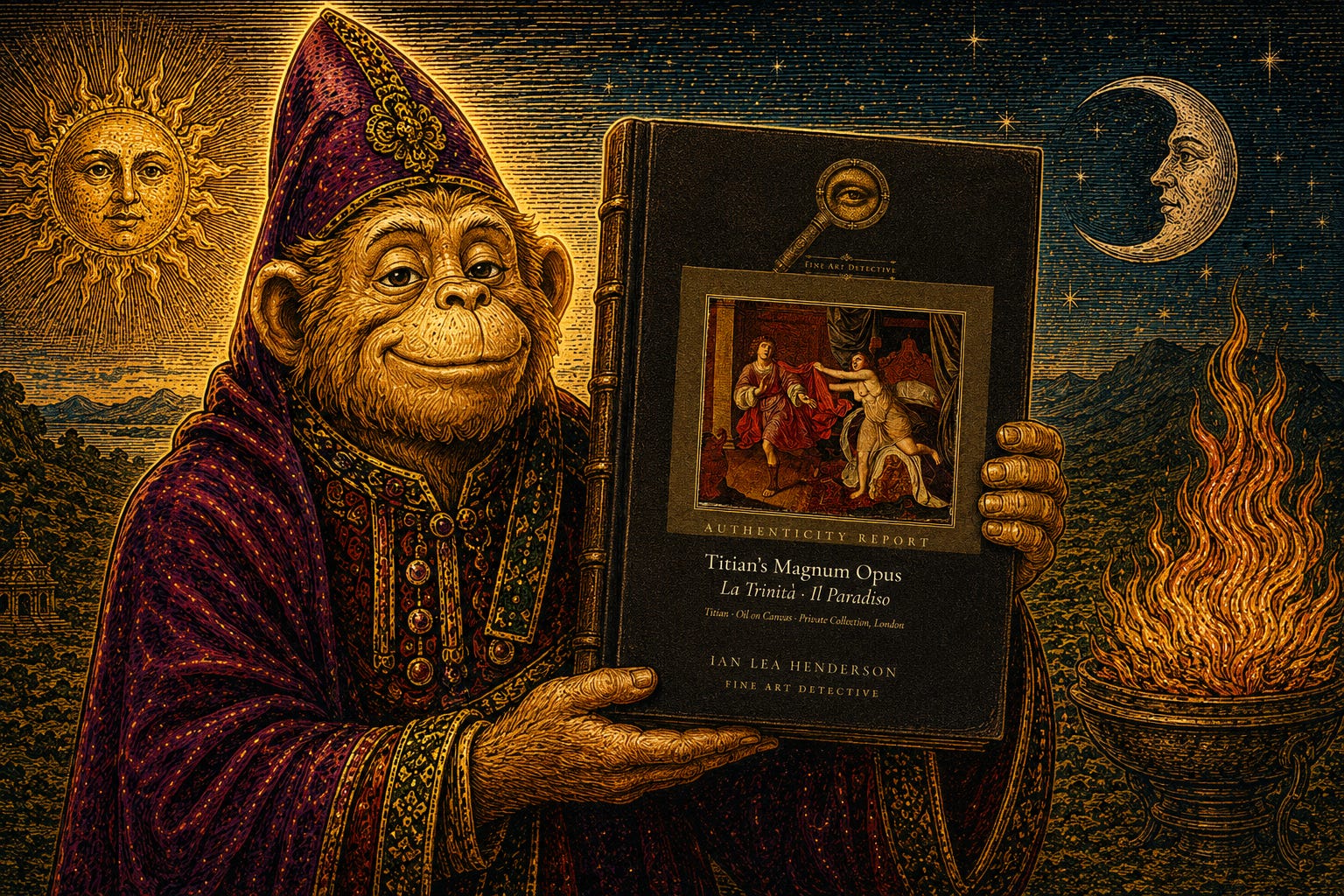
Nobody knows whether the academic world will eventually accept Ian’s conclusions about the painting.
Perhaps further examination will strengthen his case.
Perhaps independent scholars will confirm only part of it.
Perhaps the mythological interpretation will remain a compelling symbolic reading without becoming the accepted historical identification.
Those questions remain open for now.
Although something had already been proven in the room that evening.
A single object can become the centre of a human life.
A question can become a vocation.
A mystery can organize decades of attention.
The work may begin with a desire to uncover the truth about an external thing, however over time it begins revealing the person who is looking.
Patience is revealed.
Obsession is revealed.
Courage is revealed.
Blindness is revealed.
Devotion is revealed.
The capacity to continue without recognition is revealed.
That is why the language of the Magnum Opus feels appropriate.
The Great Work is not merely a grand achievement completed at the end of life.
It is the process by which a life is gathered around something worthy of devotion.
The gardener cultivates the garden and is cultivated by it.
The artist shapes the image and is shaped by it.
The scholar studies the mystery and is slowly initiated by the demands of the search.
The alchemist tends the vessel and eventually discovers that he has been inside it all along.
The Masterpiece Behind the Masterpiece
I arrived at the home of a botanical alchemist.
I entered his laboratory.
I tasted tinctures.
Then the conversation carried us backward through the Renaissance, into the world of Titian, biblical narrative, classical mythology, alchemy and the humanists who believed that knowledge should not merely inform us, but transform us.
We were not shown the physical painting.
We were shown the life built around it.
The archive of a pursuit.
The accumulated evidence of a mind refusing to abandon a question.
And perhaps that was more revealing.
A painting can remain behind glass.
Research reveals movement.
It shows where the mind has travelled, what it has gathered, where it has doubled back and which mystery continues to call it forward.
Ian’s thesis may still need to pass through the furnaces of independent scrutiny.
But his life’s work already offers another kind of truth.
Humanitas is not merely the study of humanity.
It is the cultivation of the human being.
Citrinitas is not merely a colour in an alchemical sequence.
It is the dawning of inner illumination.
The humanist gathers knowledge, experience, wisdom in order to become more fully human.
The alchemist enters the Great Work so that the lead of experience may be refined into gold.
And sometimes these two paths meet in one eccentric, excitable person on the Sunshine Coast—standing among botanical tinctures, Renaissance mysteries and decades of research, attempting to reveal the hidden depth of an inherited image.
Perhaps the greatest masterpiece is not always the one hanging on the wall.
Perhaps it is the human being slowly formed through a lifetime of devotion to the search.