
The Divine Son Wearing Different Garments
Christ, Krishna, and the Hidden Thread Through Creation

The Divine Thread Holding Everything Together
There are moments when two sacred books begin speaking to each other.
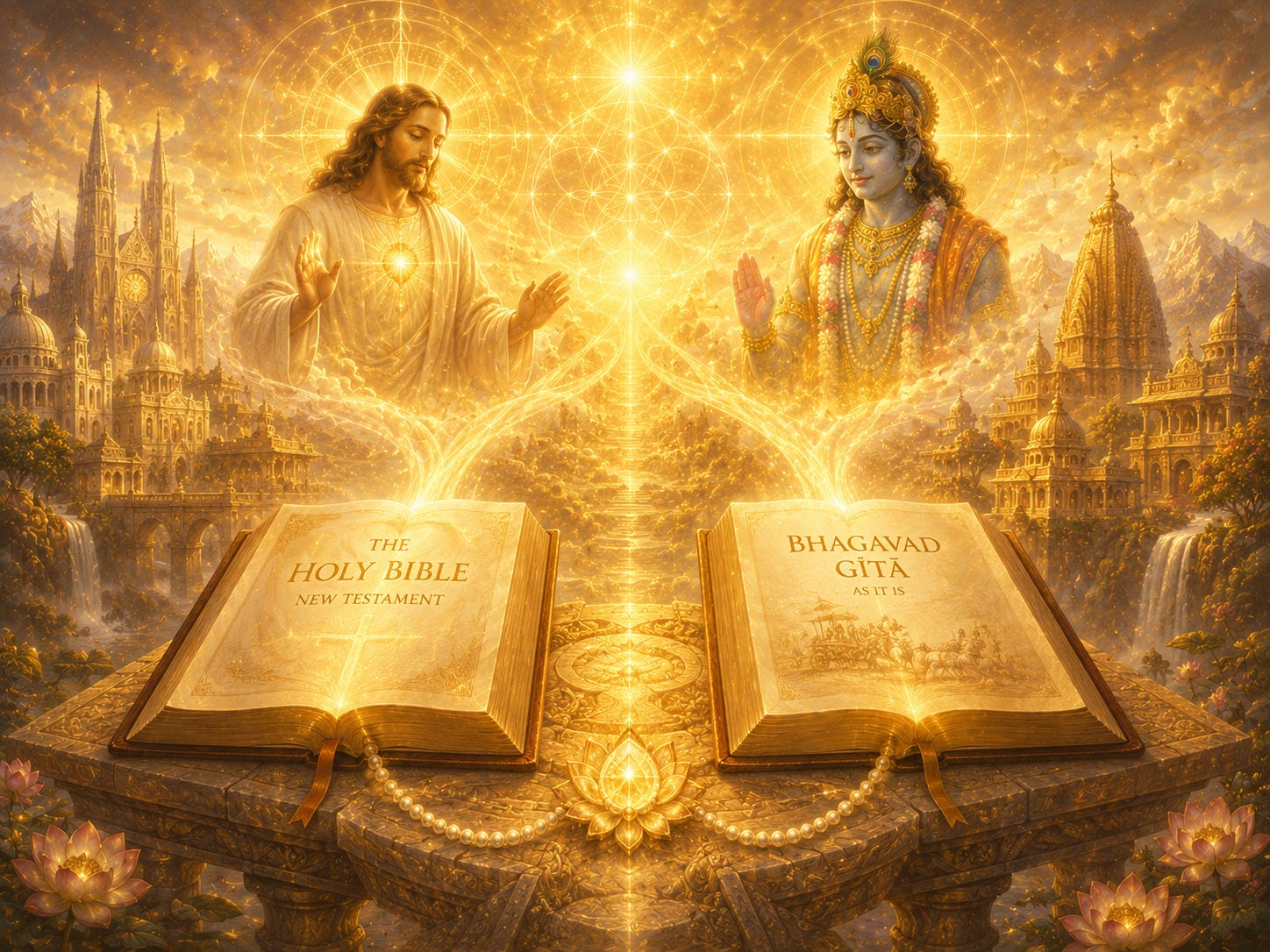
One opens the New Testament and finds Christ described as the image of the invisible God, the one before all things, the one through whom all things were created, the one in whom all things hold together. (Bible Gateway)
Then one opens the Bhagavad Gita and hears Krishna say that everything rests upon Him like pearls strung on a thread. (Vedabase)
The language is different.
The culture is different.
The sound of the temple chanting differs from the sound of the church hymn.
And still, something underneath them begins to hum.
The New Testament says Christ holds all things together.
The Gita says Krishna is the hidden thread upon which all things rest.
Two rivers.
One ocean.
For Those Who Arrive Fresh
A little orientation helps.
The New Testament is the Christian collection of writings about Jesus Christ: his life, teachings, death, resurrection, and the early communities formed around him.
The Bhagavad Gita is one of the great sacred texts of India. It is a dialogue between Arjuna, a warrior standing on the edge of a terrible battle, and Krishna, his charioteer, friend, teacher, and eventually revealed Divine Lord.
So the scenes differ.
In one, Christ is revealed through the life of Jesus and the writings of his followers.
In the other, Krishna teaches Arjuna on a battlefield and reveals Himself as the Supreme Divine Person.
One speaks from the world of Israel, Rome, cross, resurrection, church, and gospel.
The other speaks from the world of dharma, yoga, karma, devotion, battlefield, and divine vision.
And yet both offer a staggering claim:
The Divine is personal.
The Divine enters history.
The Divine sustains creation.
The Divine can be loved.
The monkey pauses there.
Because that is a very big banana to peel. 🍌
Christ as the Fullness of the Godhead
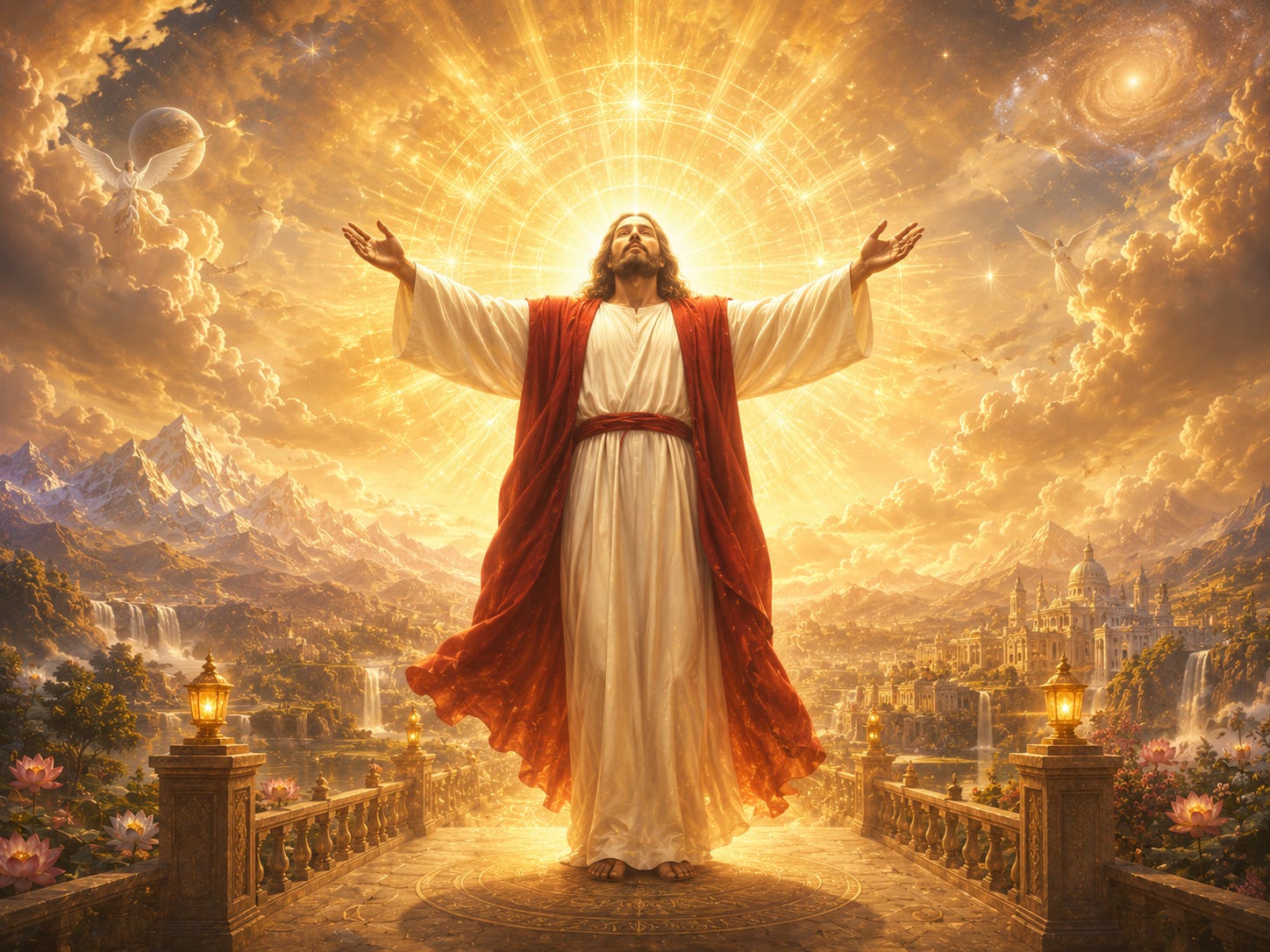
The strongest direct statement appears in Colossians:
“For in Christ all the fullness of the Deity lives in bodily form.”
That is Colossians 2:9. In older King James language, this becomes:
“All the fulness of the Godhead bodily.” (Bible Gateway)
That verse alone carries an entire universe.
It says the fullness of God is present in Christ in embodied form.
The invisible becomes visible.
The eternal takes on flesh.
The infinite becomes intimate.
John’s Gospel opens in the same cosmic register: “In the beginning was the Word,” and the Word was with God, and the Word was God. Then the Word becomes flesh and dwells among humanity. (Bible Gateway)
Hebrews says the Son is the radiance of God’s glory, the exact representation of God’s being, and the one sustaining all things by his powerful word. (Bible Gateway)
So Christ is presented as far more than a moral teacher.
He is the embodied fullness.
The divine radiance.
The creative Word.
The Son through whom the universe is sustained.
The one holding everything together.
Krishna as the Supreme Personality of Godhead
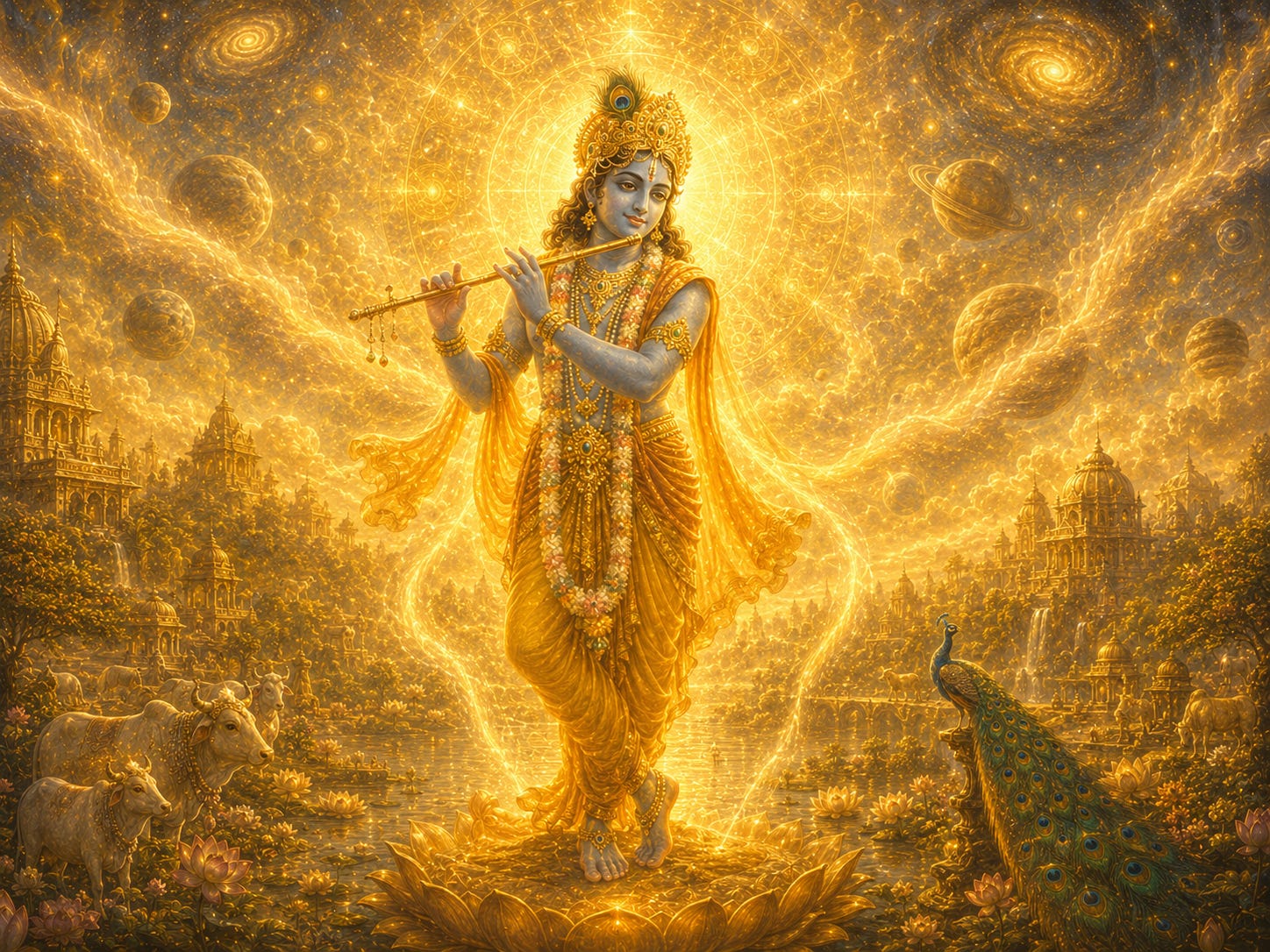
The Bhagavad Gita gives Krishna a matching cosmic scale.
Krishna tells Arjuna:
“I am the source of all spiritual and material worlds.
Everything emanates from Me.” (Vedabase)
He also says:
“Everything rests upon Me, as pearls are strung on a thread.” (Vedabase)
That pearl-thread image is simple enough for a child and deep enough for a saint.
Imagine a necklace.
Many pearls.
Different shapes.
Different positions.
Different shines.
And one hidden thread holding them together.
The pearls are the worlds, bodies, minds, duties, relationships, atoms, stars, sorrows, mangoes, temples, churches, coconuts, wounds, prayers, bananas and monkeys.
The thread is Krishna.
In Colossians, Christ holds all things together.
In the Gita, Krishna is the hidden thread of all things.
That is the correspondence that first opens the doorway.
My Devotional Reading
Here is the personal centre of this piece.
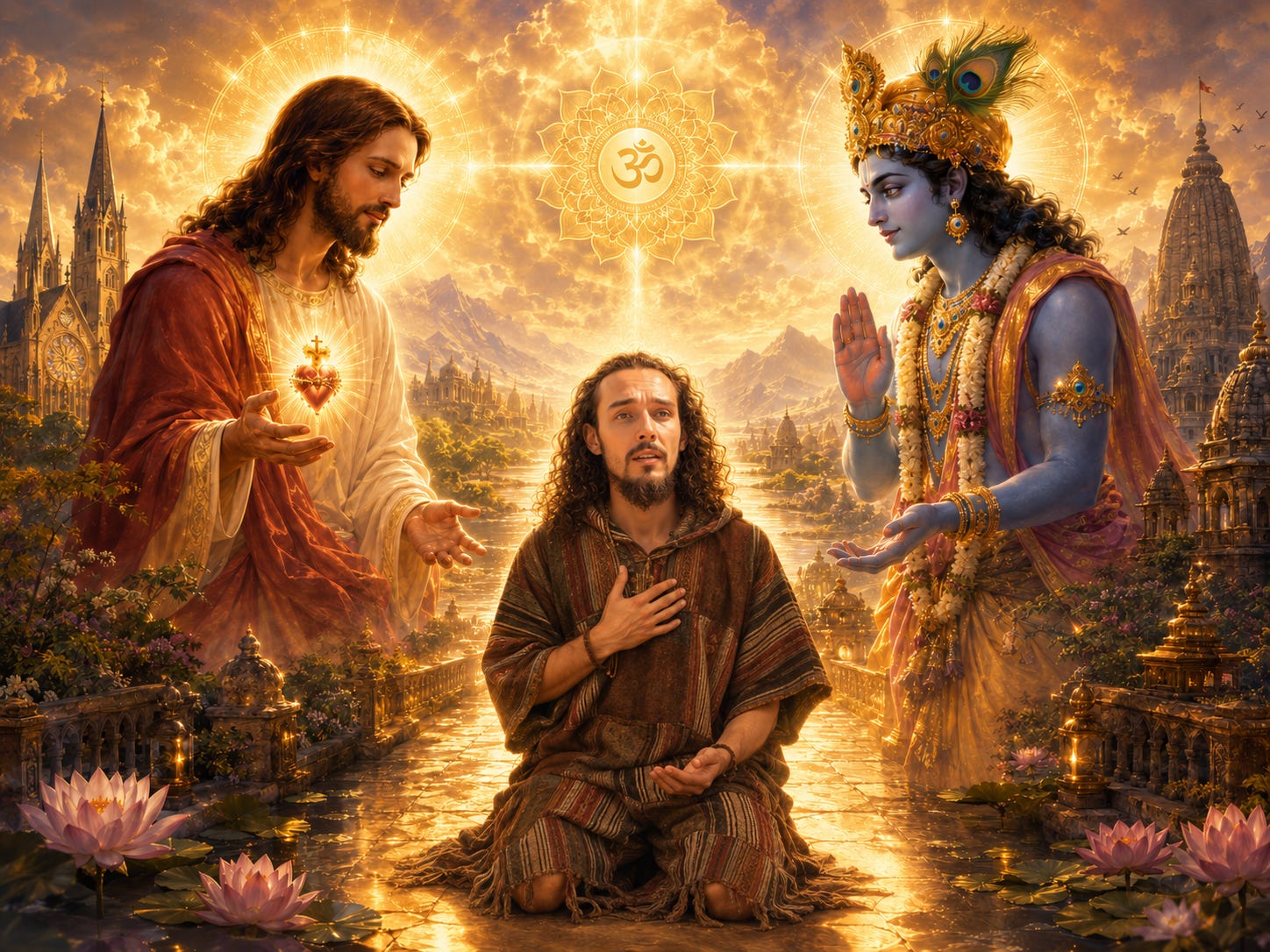
I have come to see Christ and Krishna as one and the same Divine Son — the living expression of God appearing in different times, different cultures, different forms, and different circumstances.
In the Christian river, that Divine Son appears as (Yeshua) Jesus Christ: the Word made flesh, the Son of God, the image of the invisible God, the one in whom the fullness of Deity dwells in bodily form.
In the Gita’s river, that same Divine Reality appears as Krishna: the charioteer, the Supreme Personality of Godhead, the source of all worlds, the one seated in the heart, the one who reveals the Universal Form.
This is my devotional innerstanding.
It is also worth saying plainly: different traditions explain this differently.
Many Christians will keep Christ in a unique, once-for-all place within Christian revelation.
Many Vaishnavas will keep Krishna as the original Supreme Personality of Godhead, with all divine descents flowing from Him.
Both traditions deserve respect on their own terms.
And from inside the Golden Monkey devotional lens, the resonance is alive:
One Divine Son.
One cosmic Presence.
One sustaining Consciousness.
Appearing where and when the soul of humanity is ready to receive Him.
Two rivers.
One ocean.
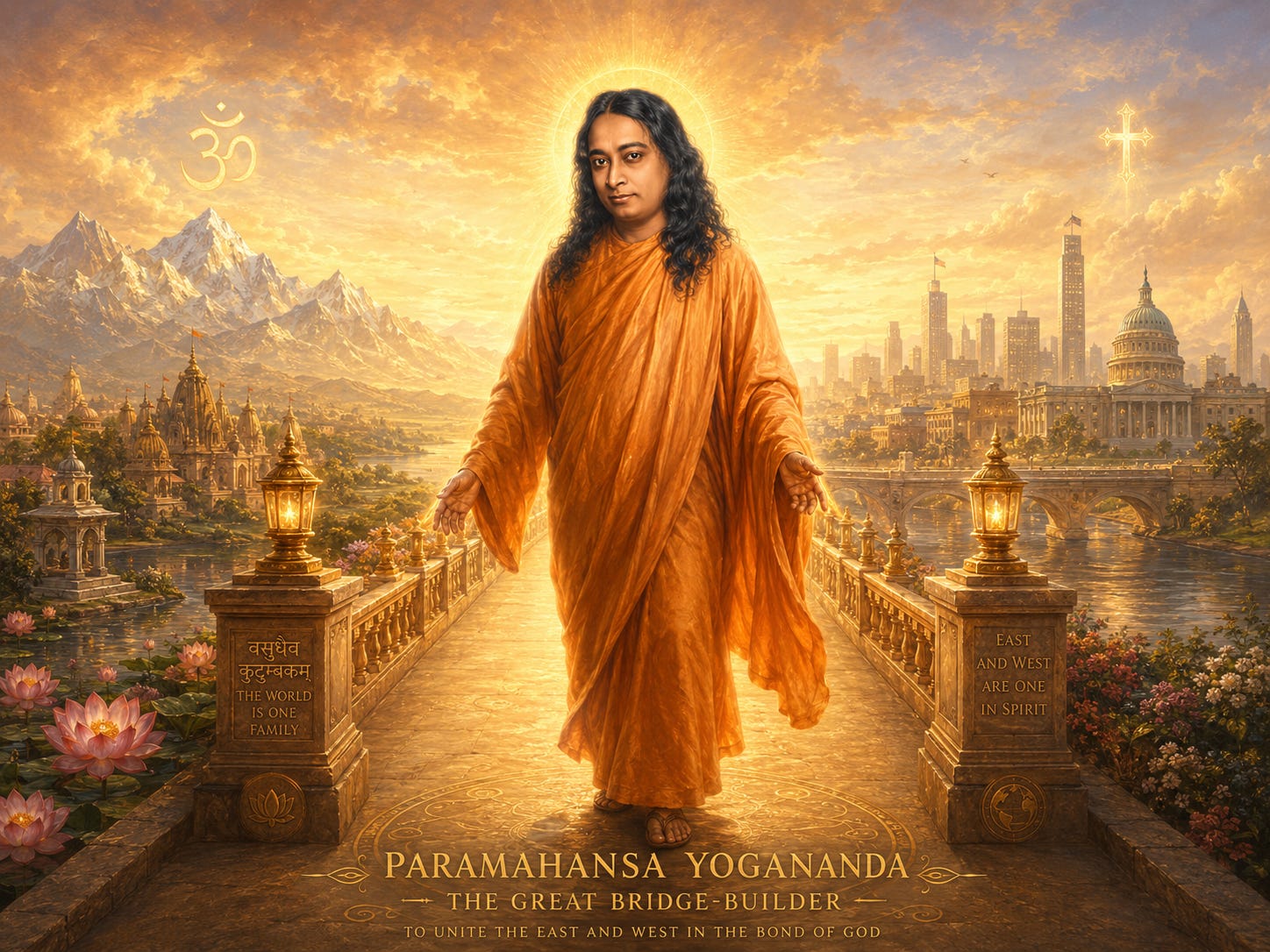
Yogananda, the Great Bridge-Builder
This is where Paramahansa Yogananda becomes essential.
Yogananda did not merely place Jesus and Krishna side by side as a pleasant interfaith gesture. His whole mission carried this bridge.
Self-Realization Fellowship states that one of Yogananda’s essential goals was “to reveal the complete harmony and basic oneness of original Christianity as taught by Jesus Christ and original Yoga as taught by Bhagavan Krishna.” (Self-Realization Fellowship)
That is the thread.
Original Christianity.
Original Yoga.
Christ.
Krishna.
Harmony.
Basic oneness.
Yogananda saw beneath the outer forms into the inner science of God-realization. He taught that the deepest religion is direct experience of God, gained through devotion, meditation, inner discipline, and awakened consciousness.
SRF also describes its spiritual lineage as founded upon the original Christianity of Jesus Christ and the original Yoga of Bhagavan Krishna, naming Jesus and Krishna as two great avatars in that lineage. (Self-Realization Fellowship)
That matters for this article because Yogananda gives permission, structure, and spiritual dignity to the comparison.
He did not flatten the rivers.
He honoured their source.
Then he pointed toward the ocean.
East and West: Inner Science and Outer Mastery
Yogananda also gave a very important civilizational frame.
He often spoke of East and West as carrying different gifts.
The West became powerful in the outward field: organization, science, technology, material progress, buildings, systems, public life, and practical achievement.
The East preserved a deep inward science: meditation, yoga, renunciation, God-realization, subtle anatomy, inner discipline, and direct communion with the Divine.
In one SRF article, Yogananda says the West has emphasized large temples of worship, while the East has emphasized the development of men of God-realization. He then adds that both spiritual centres and teachers of direct communion with God are necessary. (Self-Realization Fellowship)
He also says India can use the progressive material methods of the West, while the West can receive from India the practical metaphysical methods of Yoga by which every person may find their way to God. (Self-Realization Fellowship)
That is beautifully balanced.
The point is less “East good, West bad.”
The point is imbalance.
The West, when cut off from the soul, becomes materialistic.
The East, when cut off from embodied action, can become passive or withdrawn.
Yogananda names this directly: the Westerner tends toward constant busyness and material comforts, while the Easterner tends toward being satisfied with what already is; then he calls for the balanced road between them. (Self-Realization Fellowship)
That is the deeper union.
The West brings outward mastery.
The East brings inward realization.
One wing builds the world.
One wing remembers God.
The bird flies with both.
Christ & Krishna Come in Crisis
Christ and Krishna both appear in moments of crisis.
Christ enters a world of empire, suffering, religious rigidity, poverty, betrayal, death, and spiritual hunger.
Krishna speaks to Arjuna at the edge of battle, when action, grief, family duty, moral confusion, and spiritual awakening all collide.
Neither appears in a cave of abstraction.
Both arrive in the field.
Christ walks among people.
Krishna drives the chariot.
The Divine does not remain far away.
The Divine enters the human drama.
The battlefield becomes a scripture.
The cross becomes a doorway.
The chariot becomes a temple.
The body becomes the place where God is revealed.
That is why this correspondence matters so deeply for the Golden Monkey Life. The Golden Monkey path already lives at the meeting point of devotion, alchemy, inner work, and lived transformation; its own source architecture places Bhakti, Krishna, Hanuman, SRF, Yogananda, and the Bhagavad Gita inside the devotional root of the publication. The devotional output chamber is meant to share lived practice rather than preach belief, which fits this piece perfectly.
This is lived theology.
This is the monkey mind becoming lead in the crucible.
This is devotion entering the ordinary day.
The Word and Om
The Gospel of John gives us the Word.
The Gita gives us sacred vibration, mantra, Om, and divine speech.
John says all things were made through the Word, and that the Word became flesh. (Bible Gateway)
In yogic language, creation is also understood through vibration, sound, and consciousness. Yogananda’s bridge helps make this connection practical: meditation becomes the place where sacred sound and sacred presence are no longer ideas, but experience.
The Word is heard.
Om is felt.
The inner ear opens.
The heart begins to recognize the song under the noise.
The monkey mind chatters.
The soul listens.
The Universal Form and the Cosmic Christ
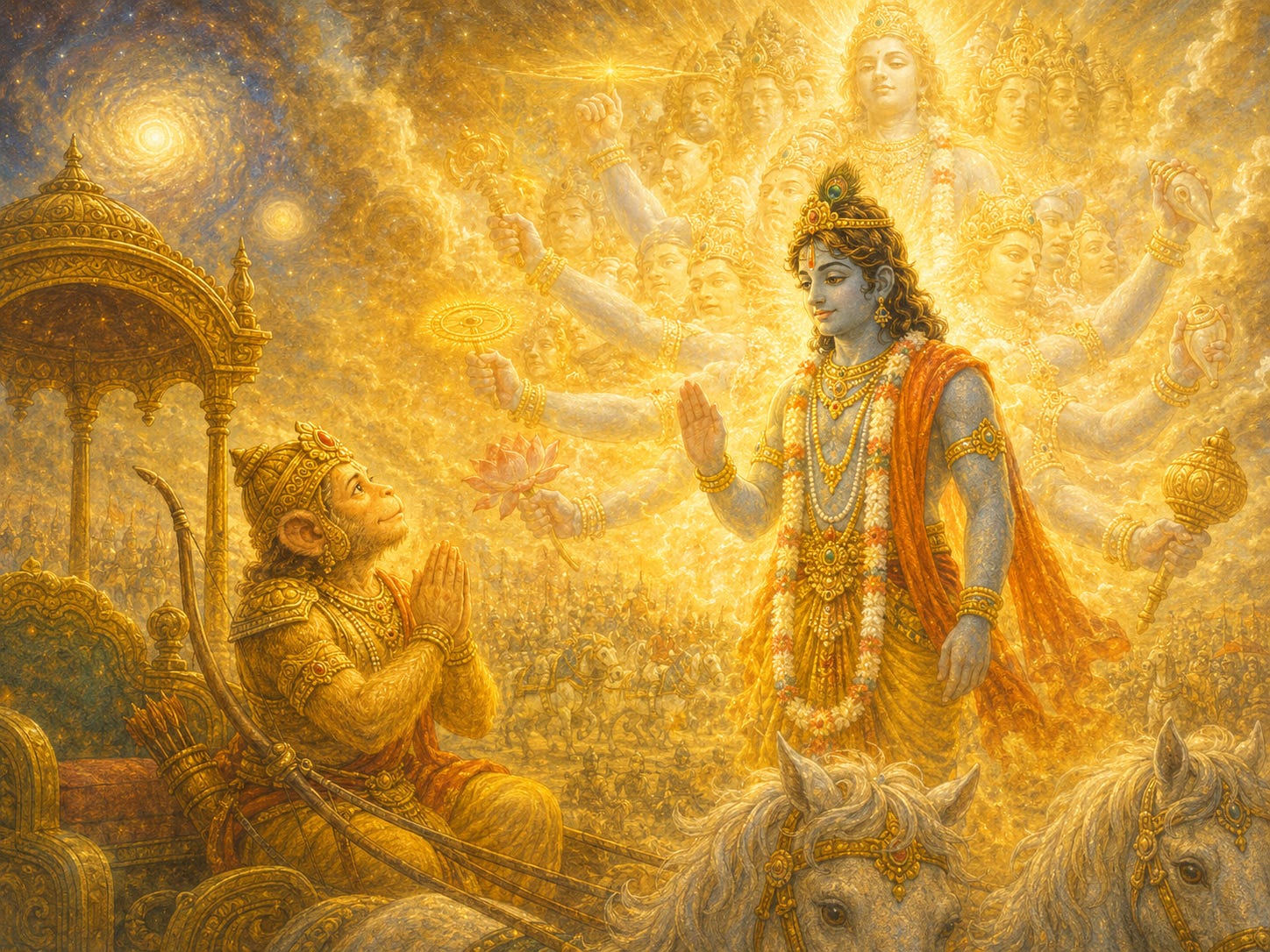
In the Gita, Krishna gives Arjuna divine sight and reveals the Universal Form. Everything moving and unmoving is gathered in Krishna’s body, in one place. (Vedabase)
In the New Testament, Christ is described as the image of the invisible God, the one through whom all things were created, the one before all things, the head of the body, and the one in whom all things hold together. (Bible Gateway)
These are different visions.
And they rhyme.
Krishna reveals the cosmos inside His body.
Christ is revealed as the cosmic Son through whom creation coheres.
One is seen in the blaze of the Universal Form.
One is sung in the language of Word, Son, fullness, body, and head.
Both break the small idea of God.
Both break the small idea of the self.
Both reveal that reality is held by a living Divine Presence.
The One Seated in the Heart
The Gita brings the cosmic down into the intimate.
Krishna says He is seated in everyone’s heart, and from Him come remembrance, knowledge, and forgetfulness. (Vedabase)
Christianity carries the same inward movement. Paul speaks of “Christ in you, the hope of glory.” The cosmic Christ is also the indwelling Christ.
That is the point where theology becomes practice.
The Divine holding the galaxies together is also present in the cave of the heart.
The thread outside is the thread inside.
The pearl-string of creation and the pulse in the chest are connected.
Yogananda’s path lives here. Through meditation, devotion, and inner discipline, the seeker turns from borrowed belief toward direct communion. SRF describes daily, scientific, devotional meditation on God as the “one divine highway” to which true religious paths eventually lead. (Self-Realization Fellowship)
The outer scripture points inward.
The inward practice opens the scripture.
The circle completes itself.
Surrender Is the Shared Door
The Gita culminates in surrender.
Krishna tells Arjuna to think of Him, become His devotee, worship Him, and offer homage to Him. (As It Is) Then comes the great final invitation: surrender unto Me. (Vedabase)
Christianity also culminates in surrender.
Christ says, “Follow me.”
Christ says, “Abide in me.”
Christ says to love God with all the heart, soul, mind, and strength.
Different language.
Same movement.
The self releases its clenched position as the centre of reality.
The heart turns toward the Divine.
The monkey loosens its grip on the steering wheel.
The chariot already has a driver.
Two Rivers, One Ocean
This is the metaphor I would use now.
Christ and Krishna are two rivers of revelation.
The Christian river carries Bethlehem, Galilee, the cross, the empty tomb, Paul, John, the church, the language of Father and Son, Word and Spirit, grace and redemption.
The Krishna river carries Vrindavan, Kurukshetra, the flute, the chariot, Arjuna, the Gita, dharma, yoga, bhakti, karma, avatara, and the Universal Form.
Each river has its own banks.
Each has its own music.
Each nourishes different lands.
And when followed deeply enough, both move toward the same ocean of Divine Reality.
From my devotional view, Christ and Krishna are one Divine Son appearing through different garments of time, culture, and need.
In the West, the Son appears as Christ, showing God through love, sacrifice, forgiveness, resurrection, and embodied grace.
In the East, the Son appears as Krishna, showing God through yoga, dharma, devotion, divine play, cosmic vision, and surrender.
The clothes differ.
The light is one.
What This Means for the Monkey Mind
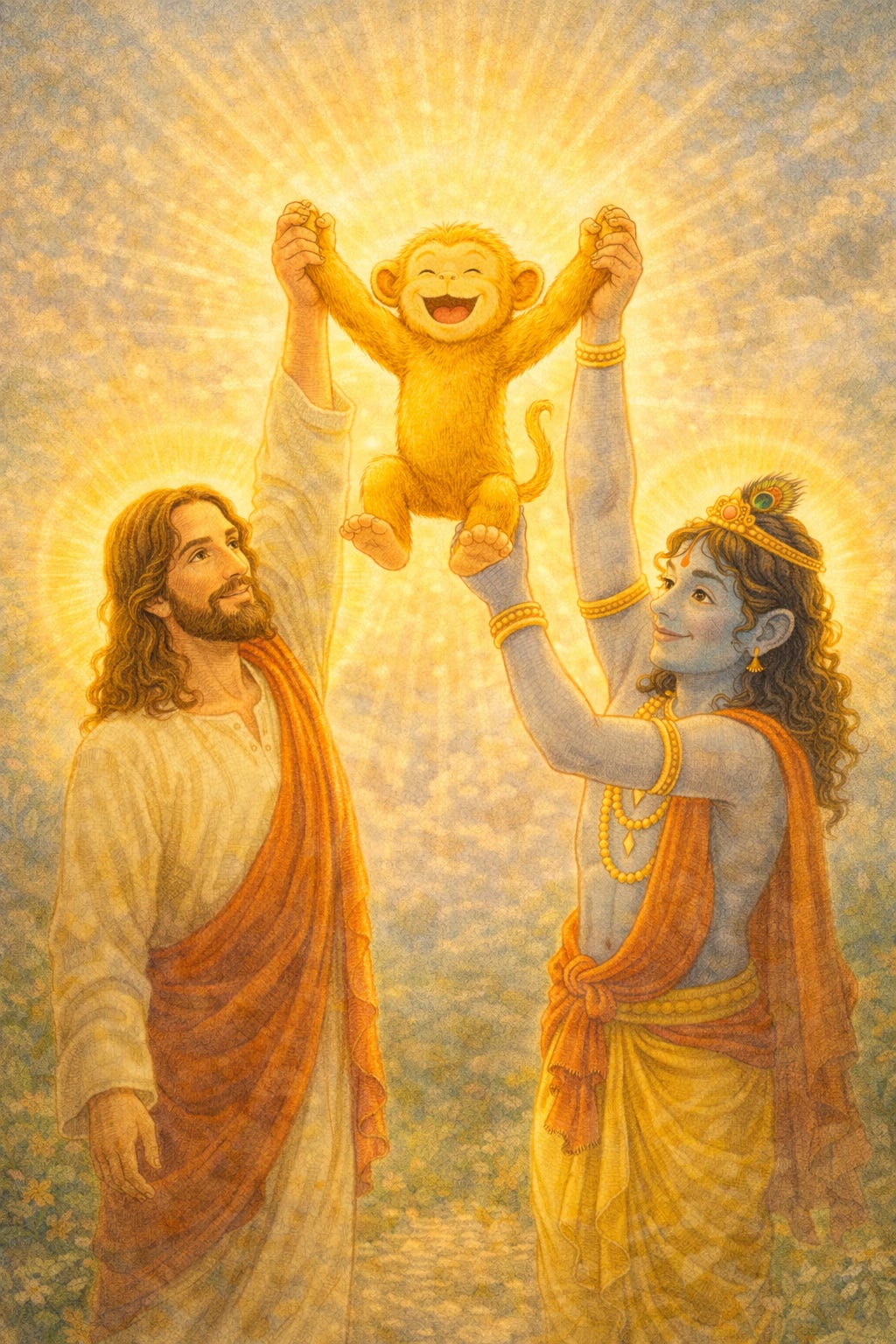
The monkey mind loves division.
Christian or Hindu.
East or West.
Inner or outer.
Faith or practice.
Body or soul.
Action or contemplation.
Christ or Krishna.
The deeper path begins to see that they are complementary.
The West built extraordinary outer instruments and, in the process, often forgot the inner temple.
The East preserved extraordinary inward instruments and, at times, needed the outward organizing force of the West.
Christ reveals the Divine entering flesh.
Krishna reveals the Divine holding the cosmos.
Yogananda reveals the bridge: direct experience of God through a balanced life of meditation, devotion, wisdom, and service.
That is the alchemy.
Outer life and inner life reunite.
Religion and realization reunite.
East and West reunite.
Christ and Krishna meet in the heart.
The monkey mind becomes less interested in winning the argument and more interested in tasting the fruit.
The Living Thread
For me, this is where the whole thing lands.
Christ is the Word made flesh.
Krishna is the thread through the pearls.
Christ is the fullness of the Godhead bodily.
Krishna is the Supreme Personality of Godhead.
Christ holds all things together.
Krishna says all things rest in Him.
Christ reveals the Father.
Krishna reveals the Universal Form.
Christ abides within.
Krishna is seated in the heart.
Yogananda stands at the bridge, smiling with that impossible serenity, pointing East and West back toward each other.
The two rivers are still flowing.
The ocean is already receiving them.
And somewhere in the middle of the whirled world, the monkey begins to remember:
The Divine was never absent.
The thread was always there.
The chariot already had a driver.
The Word was already sounding.
The heart was already a temple.
The Son has appeared again and again, wherever humanity needed the face of God close enough to love.
Two rivers.
One ocean.
One light through many windows.