

There is a strange thing that happens when one puts their hands in the soil long enough.
The garden begins teaching…
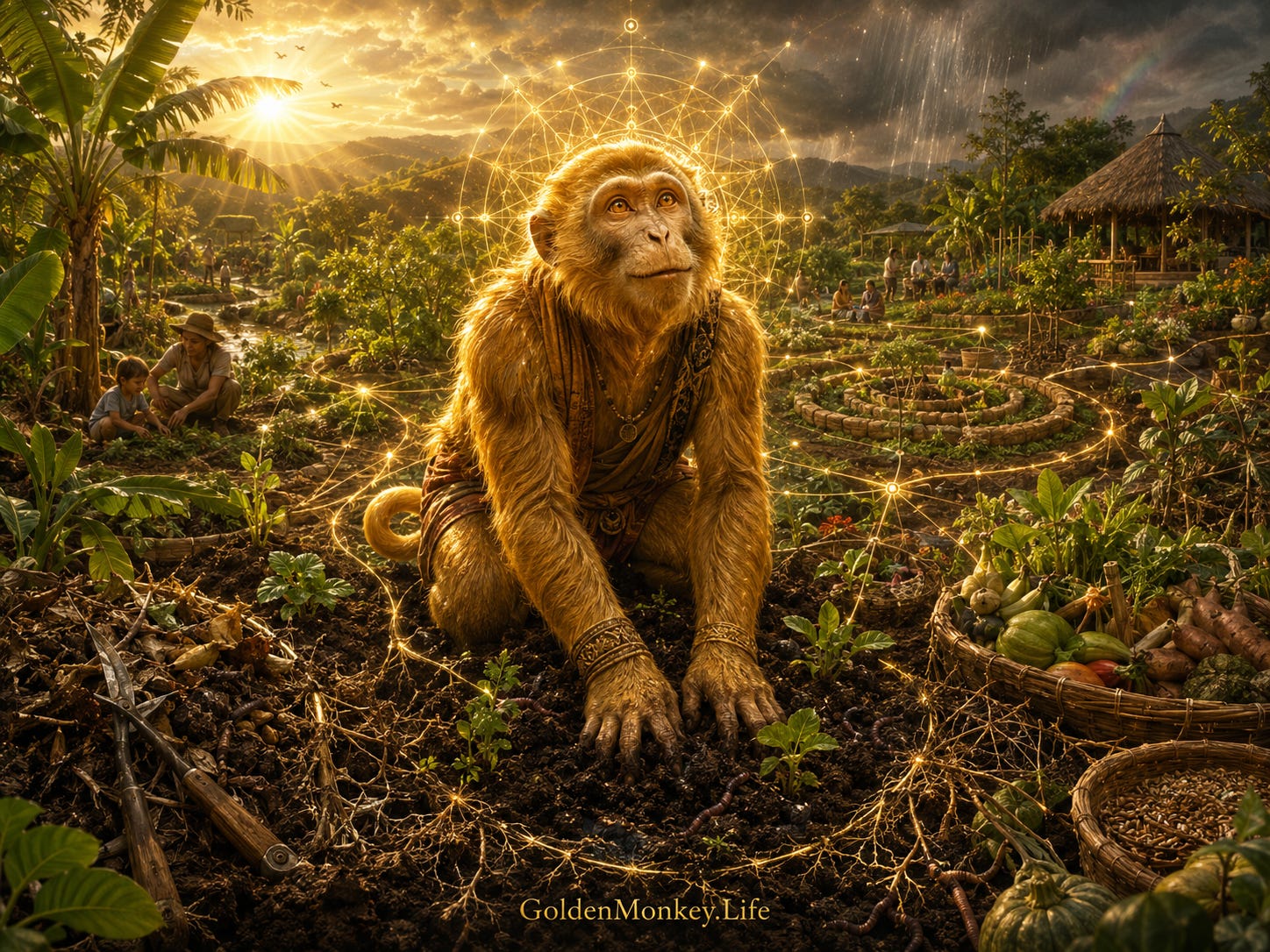
At first, it looks like compost, seedlings, swales, mulch, worms, bananas, pruning, weeds, and weather.
Then, slowly, the pattern reveals itself.
The garden is intelligence.
The garden is governance.
The garden is economy.
The garden is community.
The garden is philosophy with dirt under its fingernails.
And somewhere along the way, the monkey realises:
this was always about more than growing food.
It was about growing a way of life.
🍌🐒🌿
Where the Garden Path Began
My deeper journey into permaculture began around the beginning of the Covid era.
Like many people during that strange global pause, I found myself asking bigger questions.
Where does our food come from?
How fragile are the systems we rely on?
What happens when centralized supply chains begin to wobble?
What does true resilience look like?
And perhaps most importantly:
how does one actually live closer to life itself?
That question led me into permaculture.
I went on to participate in and complete Geoff Lawton’s Permaculture Design Certificate, becoming a certified permaculture practitioner.
From there, the rabbit hole became a root system.
I began reading.
Bill Mollison’s Permaculture: A Designers’ Manual.
David Holmgren’s Retrosuburbia.
Terry Leahy’s Permaculture Politics.
And plenty more along the way.
The books gave me maps.
The soil gave me feedback.
The community gave me… well…
Let’s call it advanced compost. 😂
Because anyone who has spent enough time around permaculture circles knows that growing food is one layer.
Growing community is another beast entirely.
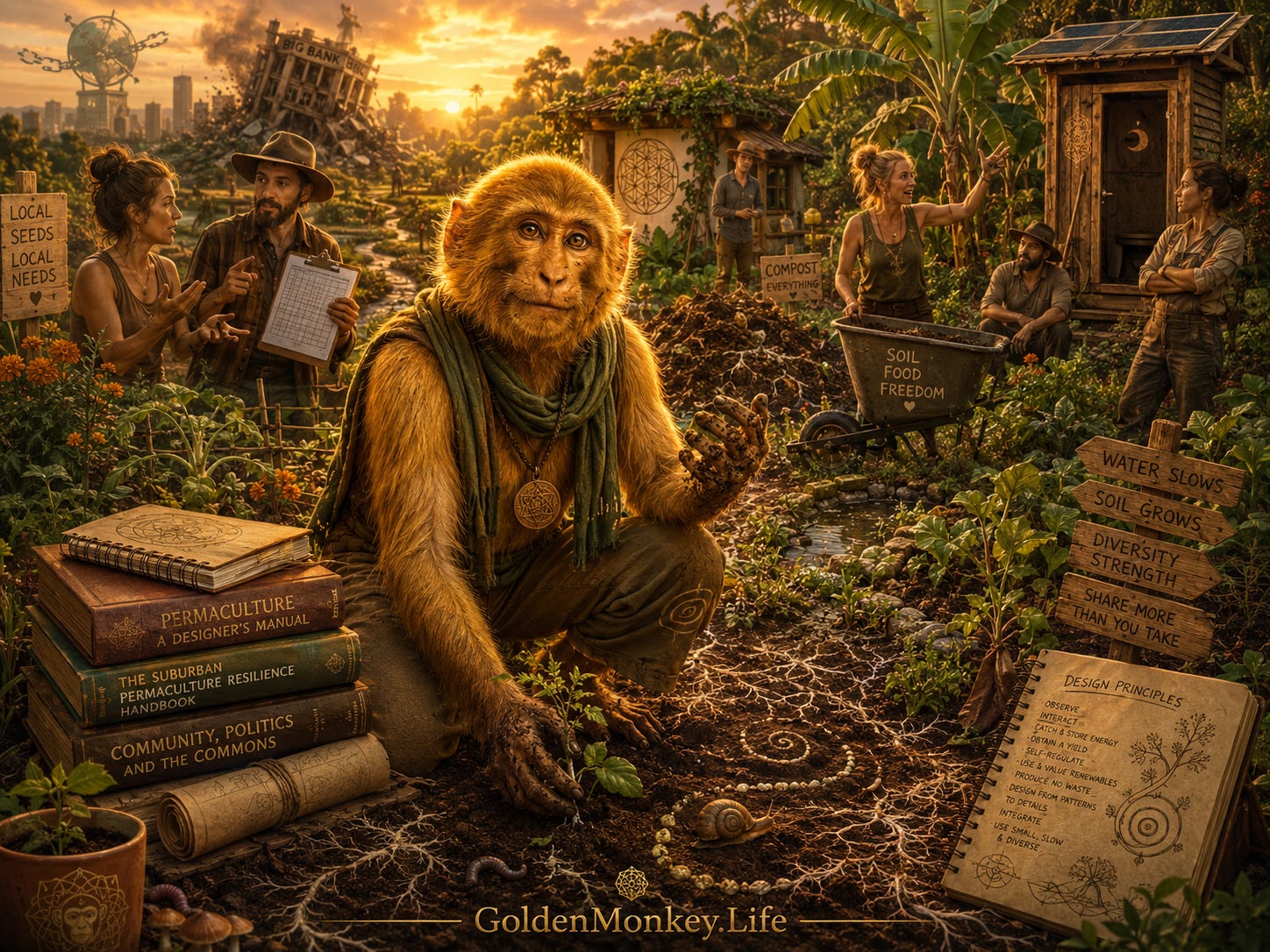
The ideals are beautiful.
Food sovereignty.
Local resilience.
Earth care.
People care.
Fair share.
And then the humans arrive.
With visions.
With wounds.
With control patterns.
With dreams.
With egos.
With spreadsheets.
With composting toilets.
With very strong opinions about who moved the wheelbarrow.
Welcome to the garden dojo.
The Hidden Politics of Soil
Permaculture taught me design principles.
Community taught me human systems.
The land teaches in cycles.
People teach in friction.
And somewhere in that meeting point, I began to see that the challenges facing permaculture were never only agricultural.
They were also social.
Economic.
Governance-based.
How do communities share resources fairly?
How do small projects fund themselves?
How do groups make decisions without falling into hierarchy, chaos, or endless meetings where one person talks about the chicken tractor for forty-seven minutes?
How do living systems coordinate?
These questions eventually led me into blockchain technology.
At first glance, that may sound like a strange jump.
From compost to crypto.
From bananas to blockchains.
From swales to smart contracts.
And yet, the pattern felt obvious to me.
Permaculture seeks to decentralize food systems.
Blockchain seeks to decentralize coordination, trust, ownership, and value exchange.
Both are asking a similar question:
What happens when intelligence is distributed across the whole network instead of controlled from one centre?
The mycelium already knew this.
The forest already knew this.
The garden already knew this.
Blockchain was simply a digital monkey waving a banana and saying:
“Hey, what if the internet started learning from the forest?”
Of course, blockchain was still very young.
Still messy.
Still full of speculation, hype, scams, noise, and digital jungle fever.
So I planted some seeds in that field.
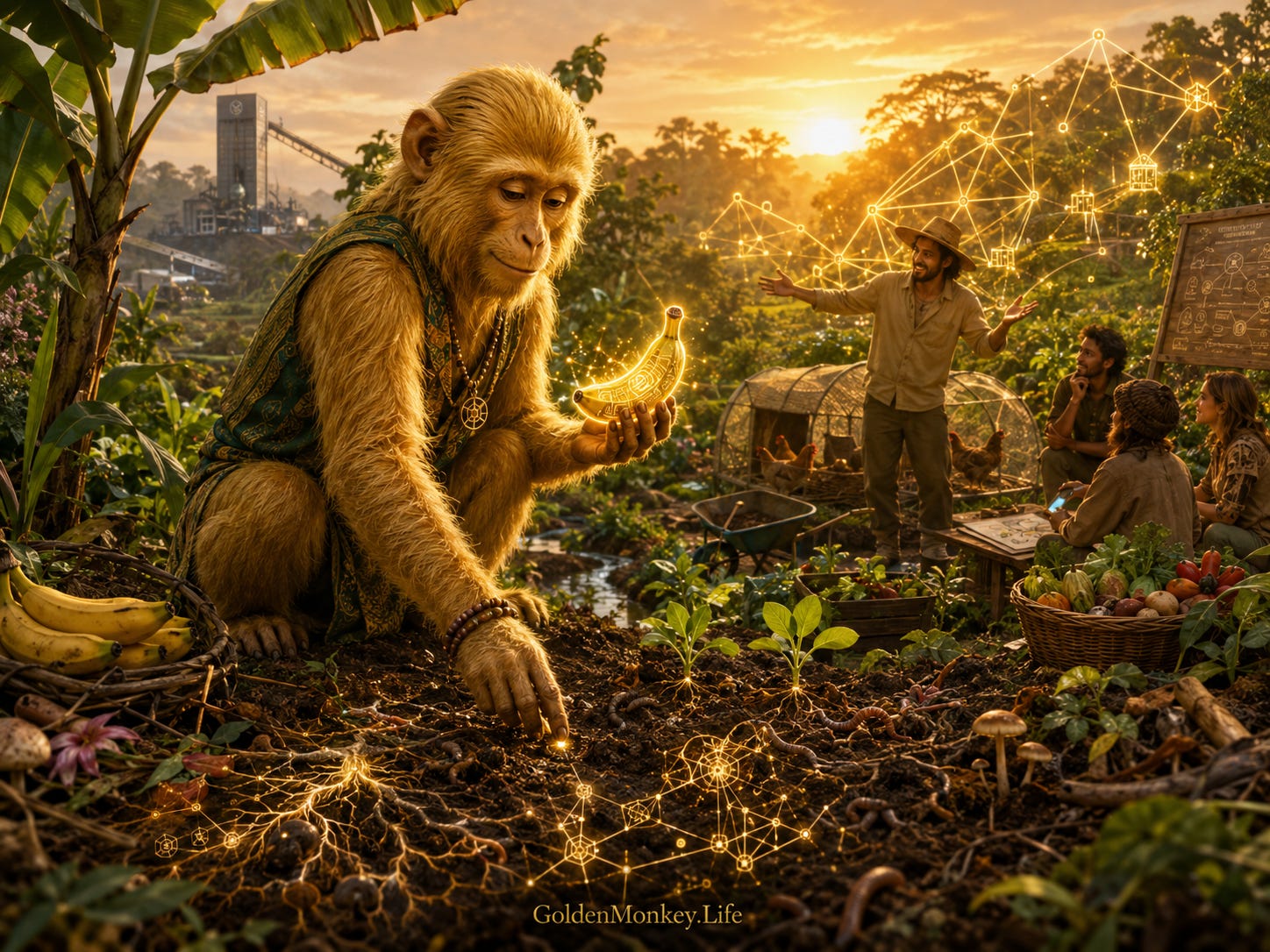
I studied.
I explored.
I philosophised.
I spoke with pioneers.
And then I kept gardening.
Because one of the oldest lessons in the soil is this:
plant the seed, tend the conditions, and release the need to force the sprout.
Some seeds take time.
Some seeds wait for rain.
Some seeds wait for a whole generation.
Banana Farm University
Eventually, my gardening journey led me into one of the most profound learning environments of my life:
an organic banana farm.
For two years, I lived and worked inside that world.
Hands in the soil.
Feet in the mud.
Body in the rhythm of the land.
Bananas everywhere.
Community everywhere.
Lessons everywhere.
This was not theory anymore.
This was embodied.
This was work.
This was sweat.
This was weather.
This was tribal dynamics.
This was the real social ecology of land-based living.
Organic farming has a way of stripping away fantasy.
The garden meme becomes the garden reality.
The romantic vision meets the heat, the insects, the timing, the labour, the economics, the personalities, the fatigue, the joy, the chaos, and the quiet beauty of watching life keep growing.
During this chapter, I also completed my Certificate III in Horticulture, adding another layer of formal training to the lived education already unfolding through permaculture and farm life.
The PDC gave me the design lens.
Horticulture gave me the science of practical plant knowledge.
The banana farm gave me initiation.
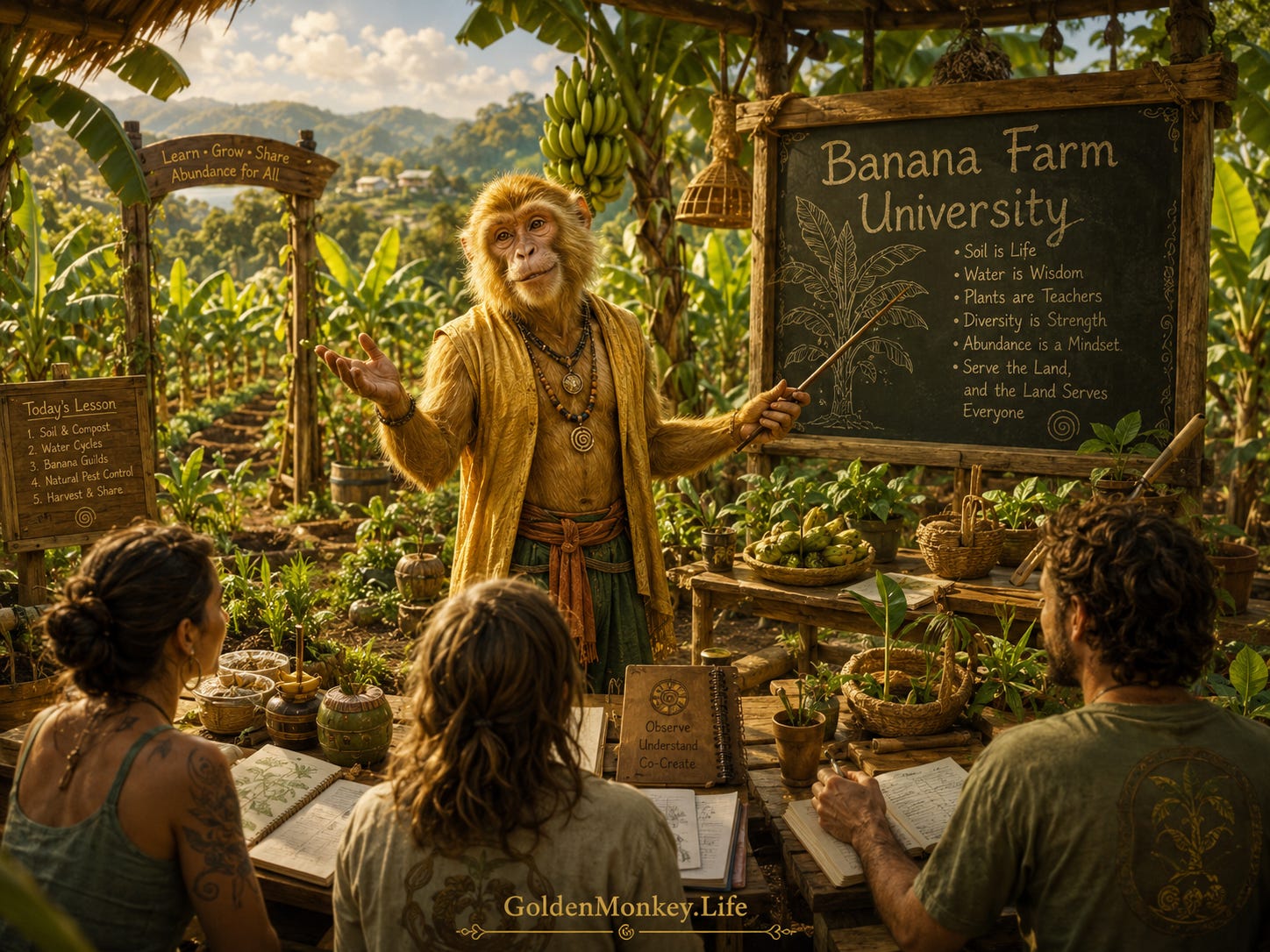
And the community dynamics gave me a very honest look at what happens when ideals touch real life.
Gold, compost, and a few flying bananas.
Mycelium, Blockchain, AI, and the Intelligence of Nature
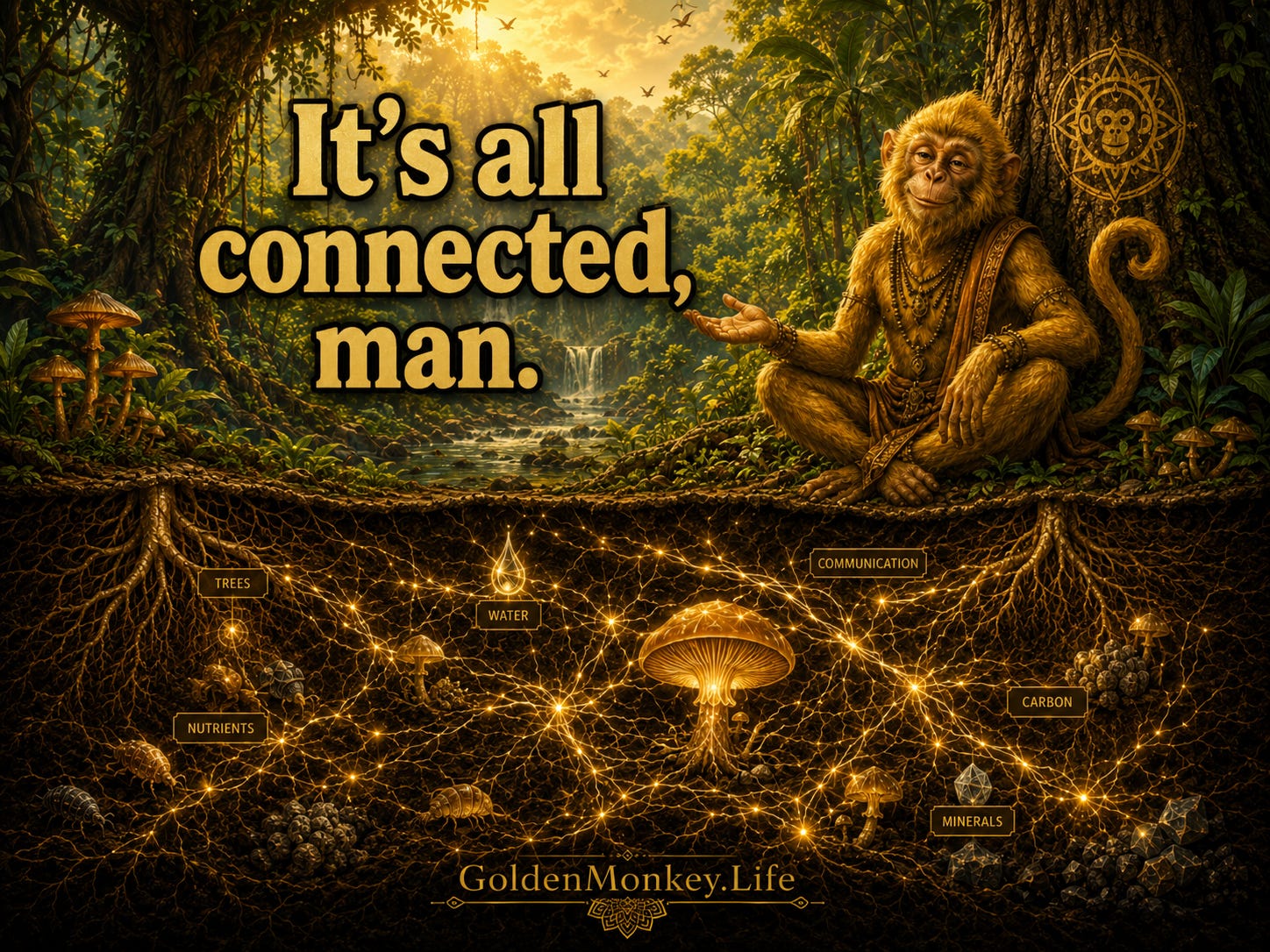
For many years, I have carried a deep fascination with mycelium.
That underground fungal network.
The great living web beneath the forest floor.
The intelligence that connects trees, moves nutrients, shares resources, responds to stress, communicates through relationship, and quietly holds entire ecosystems together.
You know the line:
“It’s all connected, man.”
Classic.
Ridiculous.
Profound.
Accurate.
The more I studied mycelium, the more I saw echoes everywhere.
In blockchain networks.
In decentralized governance.
In community economies.
In nervous systems.
In ecosystems.
In the internet.
And now, in AI.
Artificial intelligence has brought another strange jungle edge into view.
Like blockchain, it is powerful.
Like blockchain, it is dangerous when severed from wisdom.
Like blockchain, it carries both shadow and possibility.
And like every powerful technology, the question is less:
“What is this thing?”
And more:
“What kind of consciousness is guiding its use?”
AI can pull humanity deeper into abstraction, addiction, simulation, and endless digital noise.
Or AI can become a design partner for living systems.
A pattern-recognition ally.
A mycelial assistant.
A way to help communities coordinate, educate, map resources, tell better stories, prototype regenerative systems, and bring more coherence to the work of healing the land.
That is the edge I am interested in.
Not technology as escape.
Technology as trellis.
Technology as compost accelerator.
Technology as pattern mirror.
Technology in service to life.
The Edge Is Where It’s At
One of the great permaculture teachings is that the edge is where life becomes most interesting.
The meeting place between forest and field.
Water and land.
Sun and shade.
Wild and cultivated.
These edges are biologically rich because multiple systems meet there.
I believe the same applies digitally.
We are standing at a strange edge now.
AI.
Blockchain.
Mycelial intelligence.
Permaculture.
Food sovereignty.
Memes.
Media.
Community.
Living capital.
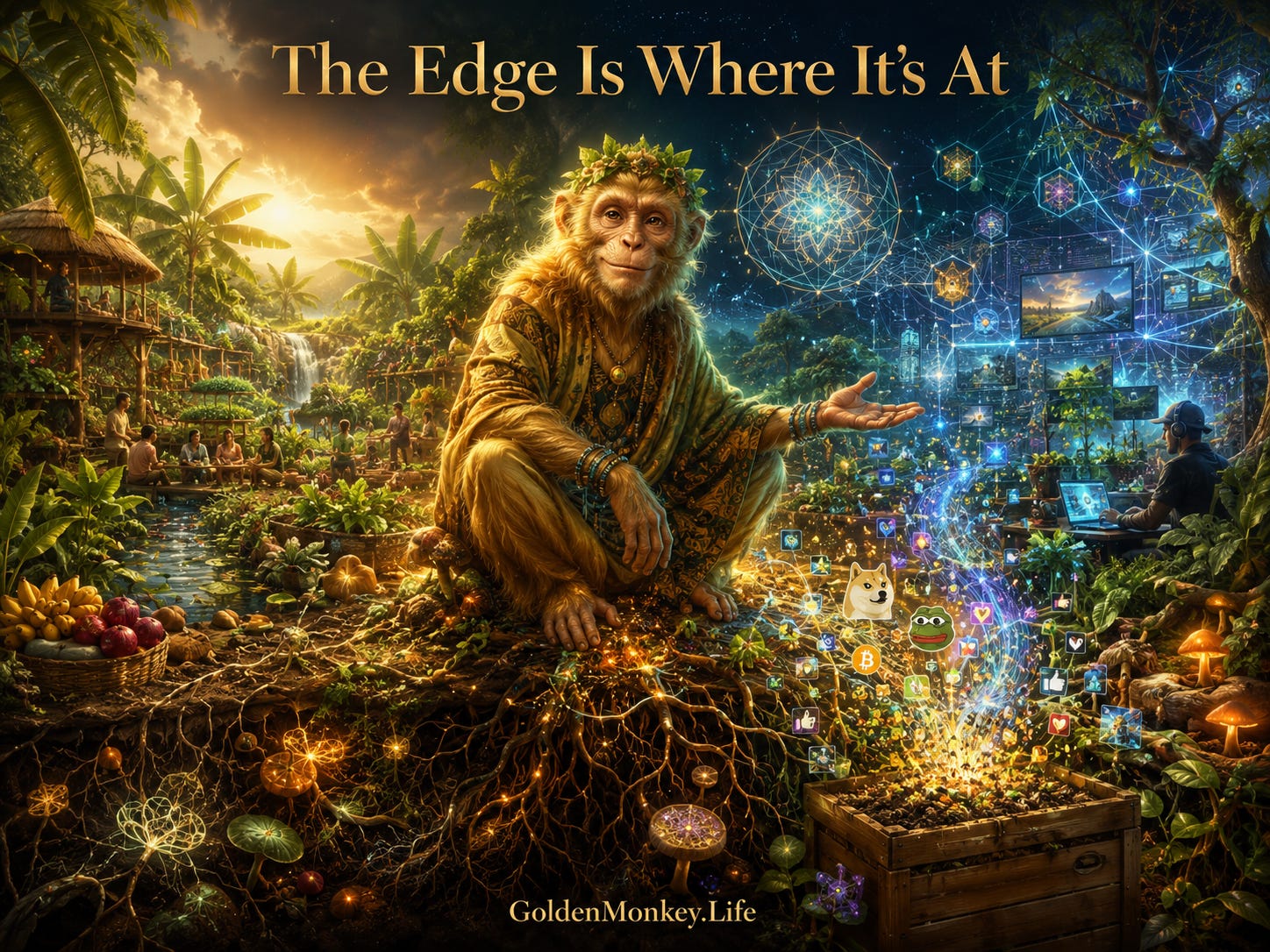
The old world wants to pull us further into screens.
The garden calls us back into our bodies.
So we have a choice.
We can choose the edge where humanity drowns in the digital realm.
Or we can choose the edge where the digital meets life.
Where attention becomes nourishment.
Where memes become gateways.
Where technology serves the garden.
Where internet culture becomes compost for real-world regeneration.
That is the edge I am here for.
That is the monkey path.
From Memes to a Way of Life
Golden Monkey Life may look playful from the outside.
Memes.
Bananas.
Alchemy jokes.
Spiritual monkey business.
A golden little trickster dancing through the algorithm.
And yes.
That is part of it.
The monkey knows how to get through the door.
Humour opens places that seriousness often cannot reach.
A meme can slip past the guarded mind.
A laugh can soften the nervous system.
A banana can become a doorway.
And yet behind the play is a very real vision.
Imagine this:
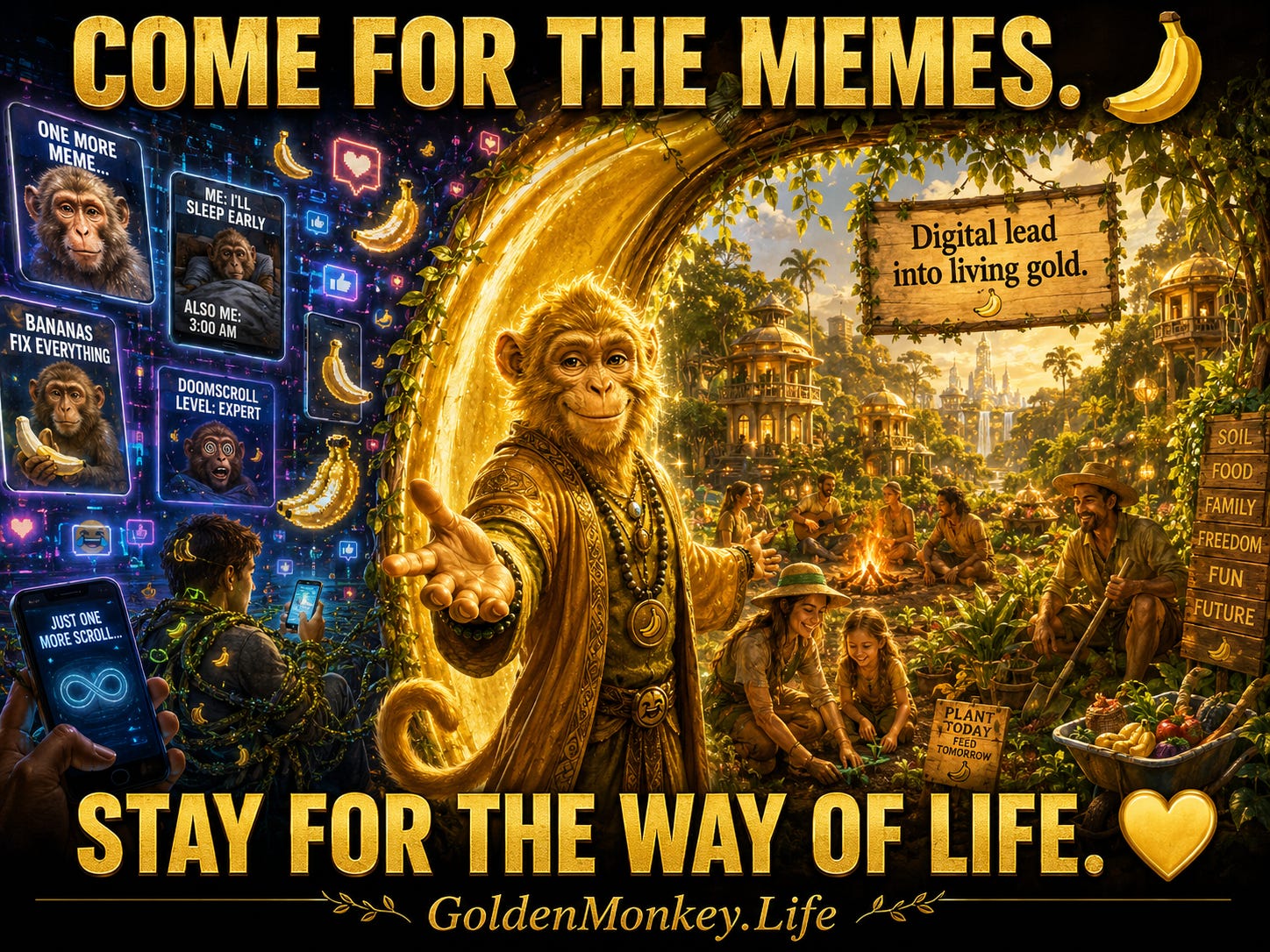
Golden Monkey memes move through the internet.
People laugh.
People share.
People arrive.
Some buy a sticker.
Some buy a shirt.
Some buy a mug.
Some support the publication.
Some join the deeper work.
And the profits from that attention begin flowing into living capital.
Soil.
Gardens.
Tools.
Nurseries.
Food forests.
Community nodes.
Regenerative spaces.
Little cities of light.
Tiny Gardens of Eden.
Places where people can come and experience what Golden Monkey Life actually means.
Not as a concept.
As a lived reality.
Hands in soil.
Food from the land.
Community around the fire.
Children seeing plants grow.
Adults remembering they belong to Earth.
Technology humming quietly in the background, serving the living system rather than replacing it.
That is the alchemy.
Human attention gets caught in doomscrolling.
The monkey catches that attention.
The meme turns it into laughter.
The laughter opens a doorway.
The doorway leads back to life.
Digital lead into living gold.
The Vision: Many Nodes, Many Gardens, Much Gold
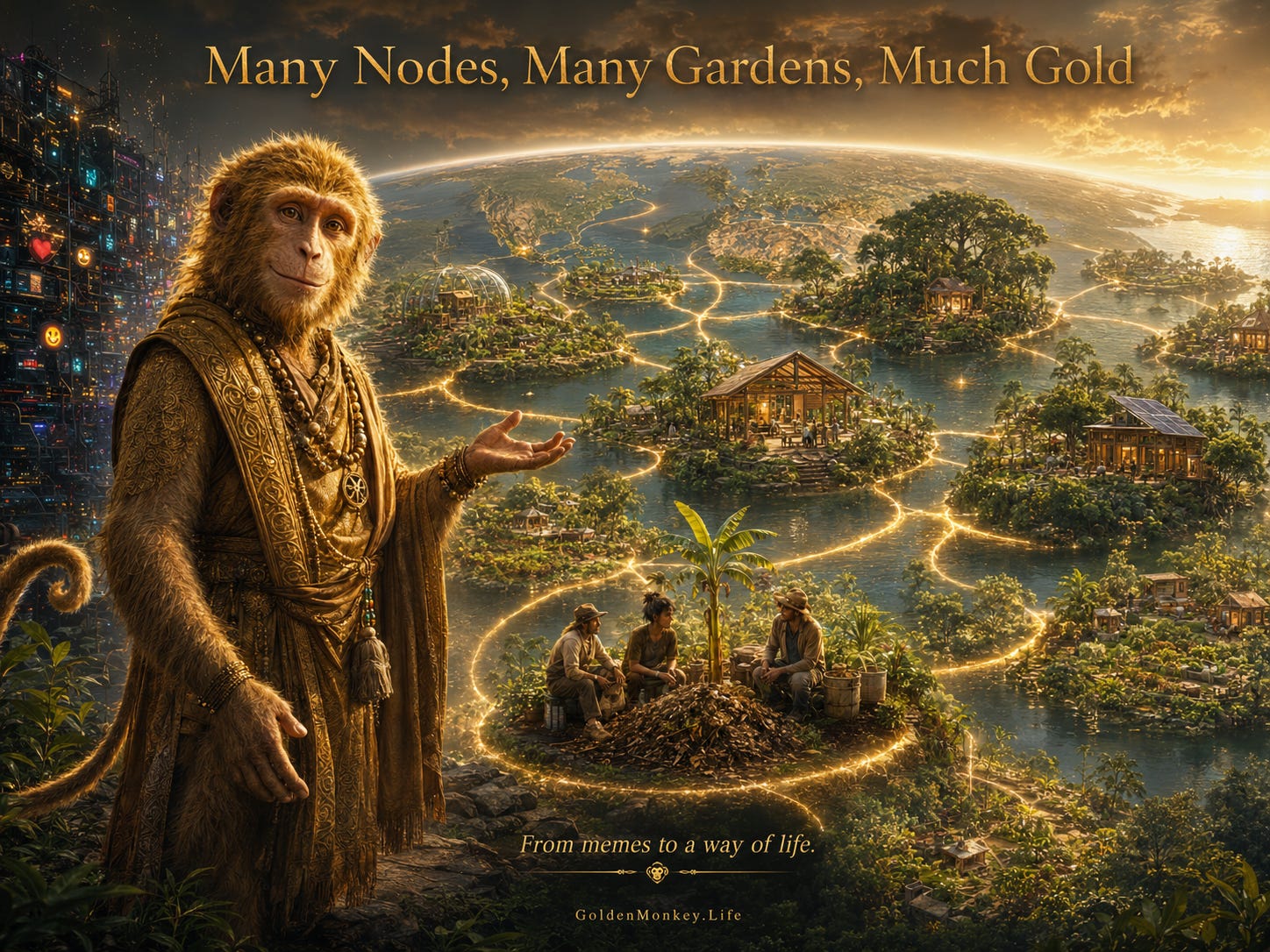
My long-term vision is simple and wildly ambitious.
Small community nodes popping up around the planet.
Gardens.
Food forests.
Local resilience hubs.
Regenerative learning spaces.
Places where people reclaim food sovereignty.
Places where land, culture, technology, spirituality, and community begin speaking to each other again.
Not one giant utopian project.
Many small living cells.
Many gardens.
Many experiments.
Many doors.
Many bananas.
Much gold.
Some may be farms.
Some may be suburban gardens.
Some may be tiny community nurseries.
Some may be food forests.
Some may be retreat spaces.
Some may be educational hubs.
Some may begin with three people, a compost pile, and one stubborn banana plant.
That counts.
The living network grows through relationship.
Just like mycelium.
Just like forests.
Just like real community.
This is the deeper aim behind Golden Monkey Life.
From memes to a way of life.
From attention to regeneration.
From monkey mind to garden mind.
From digital chaos to living coherence.
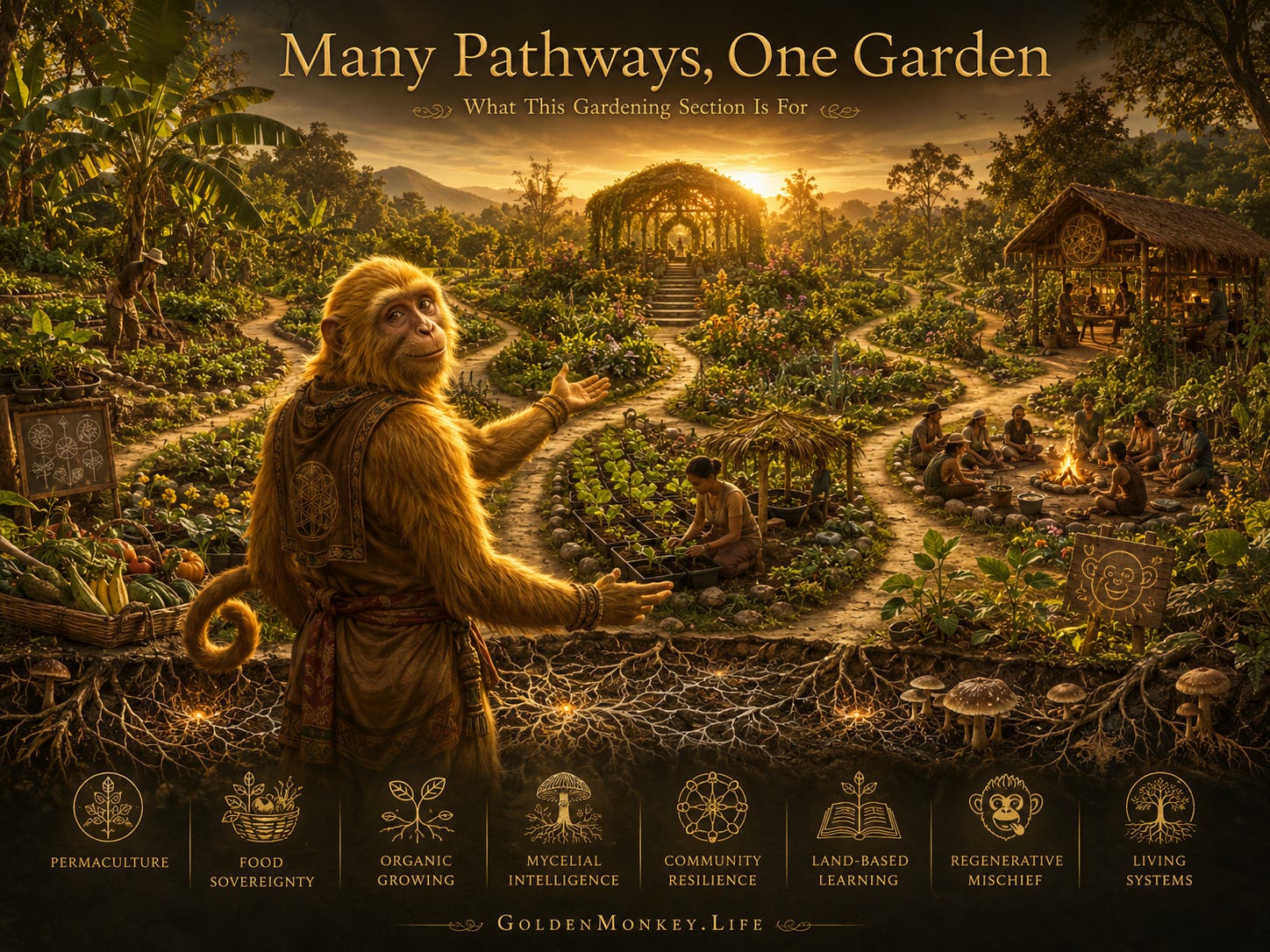
What This Gardening Section Is For
This Gardening section of Golden Monkey Life is where we return to the soil.
Here we explore:
🌿 permaculture
🍌 food sovereignty
🌱 organic growing
🍄 mycelial intelligence
🏡 community resilience
🔥 land-based learning
🐒 regenerative mischief
🌏 the living systems beneath the philosophy
Some posts will be practical.
Some will be personal.
Some will be philosophical.
Some will be ridiculous in the correct dosage.
We may talk about bananas.
We may talk about compost.
We may talk about governance.
We may talk about AI and mycelium.
We may talk about why the garden keeps exposing our control issues.
We may talk about food forests, soil health, decentralized systems, and the sacred comedy of trying to build community with humans.
Because the garden is both teacher and trickster.
It feeds us.
It humbles us.
It reveals us.
It composts our illusions.
And then, somehow, it gives us fruit.
Which pathway most interests you?
Come Back to the Garden
The digital world is moving fast.
AI is accelerating.
Blockchain is still unfolding.
The algorithm is hungry.
The monkey mind is loud.
And yet the seed still opens at its own pace.
The compost still takes time.
The banana still grows one leaf at a time.
The soil still remembers what the screen forgets.
So this section is an invitation.
Come back to the garden.
Come back to the body.
Come back to the soil.
Come back to the living intelligence that was here long before our machines began dreaming.
The future does not have to be a cold digital cage.
It can be a garden.
It can be a network of living nodes.
It can be regenerative.
It can be playful.
It can be sacred.
It can be practical.
It can have bananas.
And somewhere on the edge between meme and mycelium, blockchain and banana farm, AI and ancient soil, the Golden Monkey is grinning.
Because the joke was never that we were building a brand.
The joke was that the brand was secretly building a garden all along.
🍌🐒🌿
Welcome to Golden Monkey Gardening.
One garden. Many pathways. Much compost. Much gold.