

There are some moments in the garden that feel simple.
Plant the seed.
Water the tree.
Feed the soil.
Mulch the roots.
Welcome the bees.
And then there are other moments that are not so soft.
Moments where the gardener has to pick up the axe.
Not because we hate trees.
Not because we want to dominate nature.
Not because we have forgotten reverence.
Because sometimes love for the living web requires us to remove what is harming it. This week, the axe came out for the African Tulip Tree.
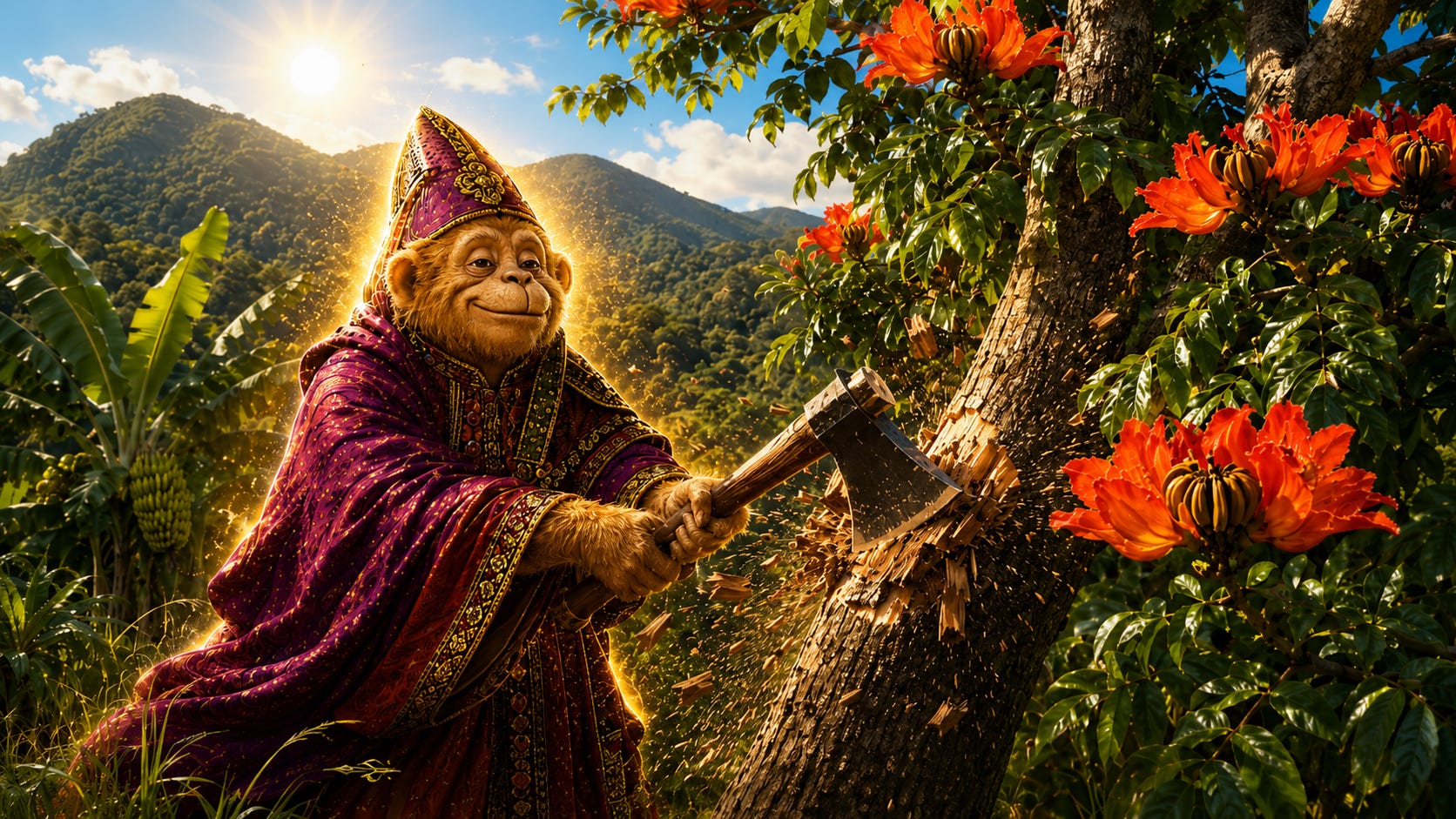
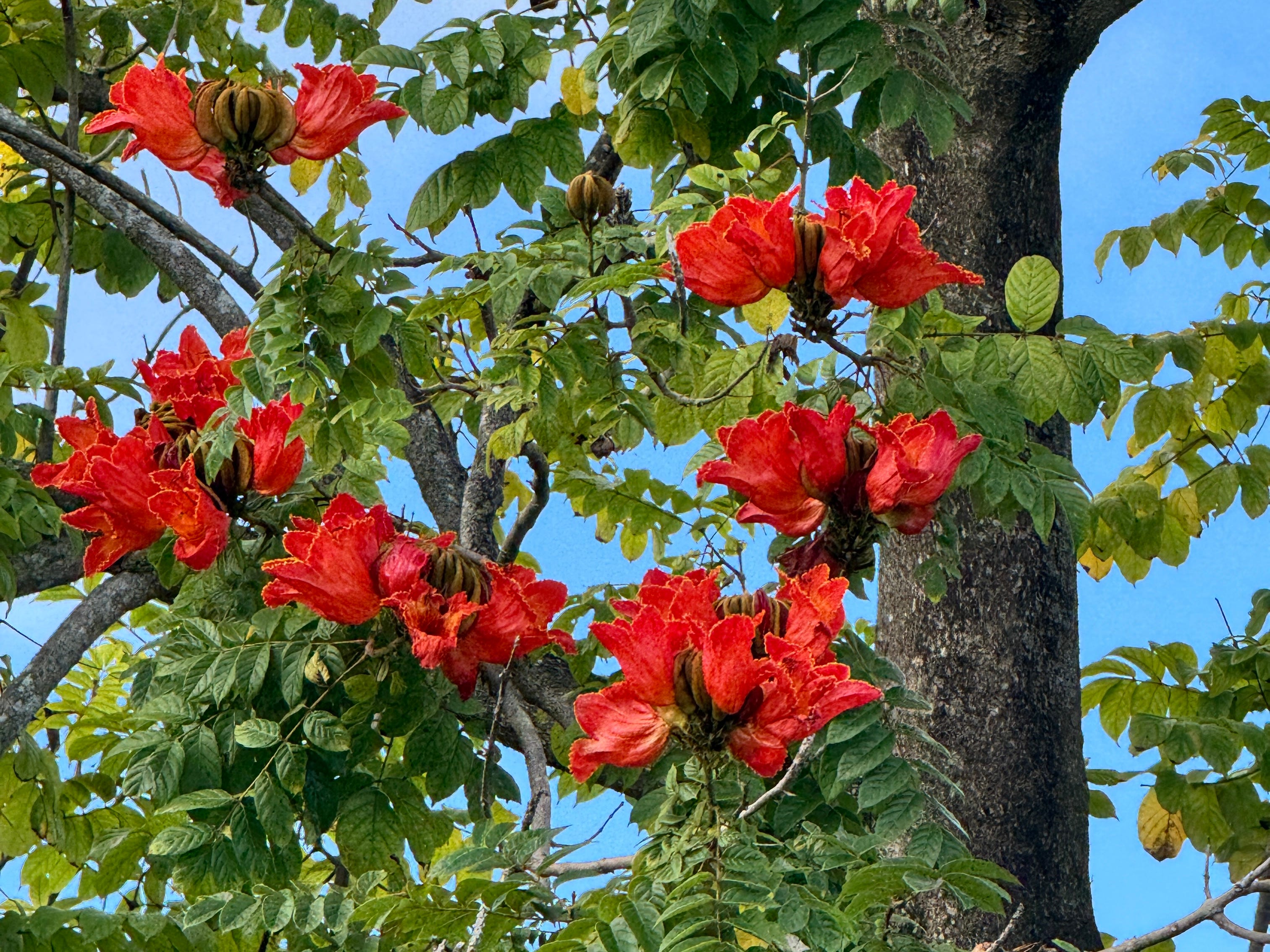
Bright orange flowers.
Beautiful from a distance.
Almost ceremonial in appearance.
A flaming crown in the canopy.
Although not all beauty belongs in every ecosystem.
And not all flowers are offerings.
Some are traps.
The Beautiful Invader
The African Tulip Tree, Spathodea campanulata, is native to tropical parts of Africa, however here in Australia it has become a serious environmental weed.
It was once planted ornamentally for its dramatic flowers and fast growth. And you can see why. It has presence. It demands attention. When it blooms, it does not whisper. It declares itself.
Although in the wrong landscape, charisma can become conquest.
In coastal Queensland and other warm regions, African Tulip Tree spreads easily. It can invade gullies, creek lines, disturbed rainforest edges, roadsides, gardens, and riparian zones. Once established, it grows quickly, forms dense stands, shades out native vegetation, and pushes itself into the ecological spaces where local plants are trying to regenerate.
This is the classic pattern of the beautiful invasive.
It arrives as an ornament.
Then it becomes an empire.
The issue is not that the tree is “evil.” In its own homeland, it has its place in the web. Although here, outside of its original ecological relationships, it behaves differently. The checks and balances are missing. The local insects, fungi, birds, and plants did not evolve with it in the same way.
So it takes more than it gives.
And in this case, the cost is not only botanical.
It is also buzzing.
The Little Ones in the Flowers
One of the most disturbing things about the African Tulip Tree is its relationship with native stingless bees.
These tiny bees are often called sugarbag bees. In this part of the world, they are more than cute little insects. They are efficient pollinators, forest workers, garden allies, and quiet custodians of genetic exchange.
They move between flowers carrying pollen like sacred dust.
They help plants communicate.
They help fruit form.
They help diversity continue.
And yet, African Tulip Tree flowers are known to kill them.
People often find native stingless bees dead inside the orange cup-like blooms. The flower becomes a kind of false temple: bright, attractive, full of promise, although fatal to the little pollinators who enter.
That image stays with me.
A bee entering a flower should be one of the most ancient relationships on Earth.
Flower opens.
Bee enters.
Pollen moves.
Fruit follows.
Life continues.
Although here the pattern is broken.
The bee enters the flower and does not return.
That is not a small thing.
In a living system, small beings perform enormous work. The health of the garden often depends on what is nearly invisible. The tiny wings. The little legs gathering pollen. The soft hum beneath the obvious story.
When the bees fall silent, the garden loses more than a pollinator.
It loses a thread in the great weaving.
Why This Matters in a Food Forest
In a food forest, we are not just growing plants.
We are cultivating relationships.
A food forest is not a collection of isolated species. It is a living conversation between roots, fungi, insects, birds, soil, sunlight, water, decay, and renewal.
The gardener’s role is not to control every sentence in that conversation.
The gardener’s role is to listen, respond, and guide the system toward greater life.
That means planting food.
That means feeding soil.
That means protecting water.
That means increasing diversity.
That means watching which species support the web, and which species begin to unravel it.
The African Tulip Tree may look magnificent, however if it is killing native stingless bees, spreading into waterways, and crowding out native regeneration, then it is not serving the living system here.
It is taking the shape of beauty while causing harm.
And this is where the gardener must become honest.
Sentimentality is not the same as compassion.
Sometimes we avoid removing a plant because it is big, beautiful, flowering, familiar, or emotionally charged. We say, “But it’s alive.” And yes, it is alive.
Although so too are the bees.
So are the native seedlings trying to rise beneath it.
So are the creek banks.
So are the future forests.
So are the fruiting systems that depend on pollination.
Compassion must widen its gaze.
The Bees and the Banana Experiment

This has become especially important to me because I am working with a seed banana cross-pollination project.
The dream is simple, ancient, and slightly mischievous.
Bring seeded banana genetics into relationship with cultivated varieties. Let the flowers open. Let the insects move. Let the bees, beetles, wind, and living intelligence of the place participate in the experiment.
Somewhere in that dance, new genetics may emerge.
Maybe nothing obvious happens.
Maybe something surprising happens.
Maybe a seed forms in a fruit where it was not expected.
Maybe a future banana carries a little more resilience, a little more wildness, a little more memory of the forest.
This is not laboratory breeding.
This is garden alchemy.
The seeded banana is the wild teacher.
The cultivated banana is the refined vessel.
The pollinator is the messenger between worlds.
And among those messengers, the native stingless bees matter.
They are tiny golden couriers moving through the garden with more purpose than most humans notice. They do not need applause. They do not need a philosophy. They simply do their work.
They enter the flower.
They carry the pollen.
They serve the continuation of life.
So when a tree on the land is killing those messengers, it is not a neutral presence.
It is interfering with the ceremony.
And when you are trying to create new food genetics, protect pollinators, and build a resilient food forest, the protection of those tiny beings becomes part of the work.
The axe is not separate from the banana project.
The axe is part of the banana project.
The removal of the harmful tree creates more safety for the pollinators that may help carry the next genetic possibility into being.
The Gardener’s Battlefield
This is where my mind went to the Bhagavad Gita.
Arjuna stands on the battlefield, overwhelmed.
He does not want to fight.
He sees teachers, relatives, friends, and respected elders on the opposing side. His heart breaks at the thought of raising his bow. He questions the whole thing. He would rather withdraw than participate in violence.

And Krishna does not give him a shallow answer.
Krishna does not say, “Just be peaceful and avoid the conflict.”
Nor does he say, “Fight because you are angry.”
Krishna teaches him about dharma.
Duty.
Right action.
The action that must be taken, not from ego, hatred, or personal desire, but from alignment with the deeper order.
Arjuna must act.
Not because battle is glorious.
Because refusing his duty would also have consequences.
This is a powerful teaching for the garden.
Because the gardener also faces moments of hesitation.
Do I cut the tree?
Do I remove the invasive?
Do I disturb what is already growing?
Do I intervene?
Do I let nature sort it out?
Sometimes the answer is to wait.
Sometimes the answer is to observe.
Sometimes the answer is to soften the hand.
Although sometimes the answer is to pick up the axe.
Not as a weapon of anger.
As an instrument of dharma.
The African Tulip Tree is not my enemy.
However my duty is to the whole system.
My duty is to the bees.
To the native plants.
To the waterway.
To the food forest.
To the future fruit.
To the unseen relationships that make life possible.
In that moment, the axe becomes the bow of Arjuna.
The garden becomes the ancient battlefield.
And the teaching is this:
Do what must be done, without hatred in the heart.
Not All Destruction Is Violence
This is an important distinction.
Destruction can be violent, careless, extractive, and arrogant.
Although removal can also be restorative.
A surgeon cuts to heal.
A pruner cuts to strengthen.
A fire clears old fuel so new growth can emerge.
A gardener removes an invasive so the living web can breathe again.
The consciousness behind the action matters.
If I cut because I am angry, I feed anger.
If I cut because I want control, I feed domination.
However if I cut because the bees are dying, because the forest is being crowded out, because the garden is asking for protection, then the cut belongs to stewardship.
The axe can be crude in the wrong hands.
Although in the hands of a listening gardener, it can become a tool of ecological responsibility.
That does not mean we swing blindly.
It means we learn.
We identify correctly.
We understand the species.
We consider safety.
We observe where it is growing.
We prevent spread.
We replace what we remove with better relationships.
The goal is not an empty space.
The goal is succession.
When the African Tulip Tree comes down, something else should rise.
Native flowering trees.
Bee-friendly shrubs.
Food plants.
Medicinal plants.
Diverse habitat.
A better offering.
The wound becomes a doorway.
Beauty Is Not Enough
The African Tulip Tree teaches a difficult lesson.
Beauty is not enough.
A plant can be stunning and still harmful in the wrong place.
A flower can shine like fire and still be a trap.
A tree can appear generous while quietly impoverishing the web around it.
This is true beyond the garden too.
Some ideas are like that.
Some habits are like that.
Some systems are like that.
They look impressive. They flower brightly. They attract attention. However when you look underneath, the bees are dead in the cup.
The alchemical question is not, “Is it beautiful?”
The deeper question is, “What does it do to the living field?”
Does it increase life?
Does it support diversity?
Does it feed the small and unseen?
Does it belong in relationship with this place?
Or does it dominate, extract, and silence?
The garden teaches discernment.
Not all gold-coloured things are gold.
Not all flowers are offerings.
Not all growth is good growth.
After the Axe
After the tree comes down, the work continues.
The stump may need managing. African Tulip Tree can sucker and regrow, especially when disturbed. Seedlings may appear. Follow-up matters.
This is another part of ecological duty.
It is not enough to perform one dramatic act and call the job done.
The garden respects consistency.
Cut.
Watch.
Return.
Mulch.
Replace.
Regenerate.
This is how we turn removal into restoration.
And this is where the Golden Monkey Gardening path becomes very practical.
Spiritual ecology is not just poetry about nature.
It is noticing which trees are killing bees.
It is learning the difference between a native flame tree and an invasive African Tulip Tree.
It is protecting the pollinators.
It is planting the next layer.
It is putting your philosophy through the hands, the sweat, the blade, the soil.
Anyone can love nature in theory.
The garden asks what your love is willing to do.
The Monkey, the Bee, and the Axe
So this was not just a tree removal.
It was a teaching.
The African Tulip Tree stood there in its strange beauty, holding its orange cups to the sky.
The bees entered.
Some did not return.
The bananas flowered nearby, waiting for messengers.
The food forest asked for a decision.
And somewhere in the background, Krishna whispered to Arjuna:
Act.
Not from hatred.
Not from ego.
Not from fear.
Not from laziness disguised as peace.
Act from duty.
Act for the whole.
Act in service of life.
So the axe came out.
And the monkey bowed.
Not to destruction.
To dharma.
Next up in Golden Monkey Gardening:
The Seed Banana Experiment — wild genetics, tiny pollinators, and the alchemy of ancient genetics to future fruit.